Translated automatically by AI from the Italian original.
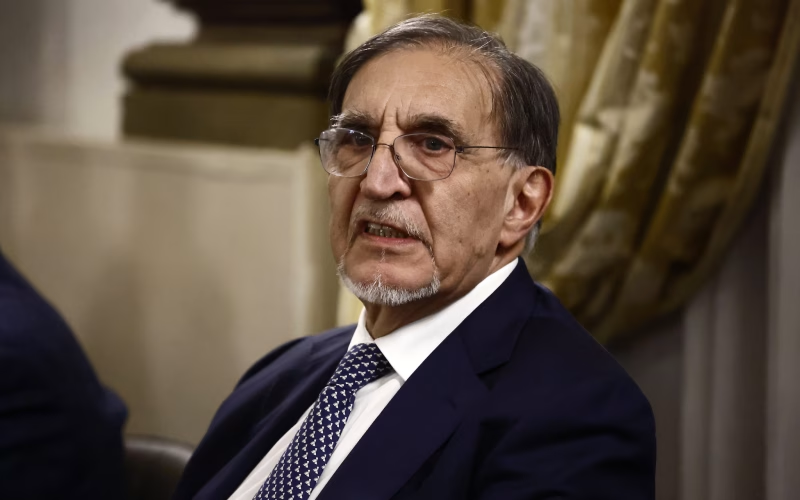
MILAN / POLITICS – The remarks by the Senate president Ignazio La Russa are once again at the centre of a fierce political clash. Speaking in Milan at the initiative “Young people of sound and robust Constitution” in front of an audience of high-school students, the second-highest office-holder in the state addressed the issue of popular sovereignty, the rise of the fascist regime and the origins of the constitutional charter, immediately triggering an outcry from opposition forces.
In defending the legitimacy of voters’ choices and clashing with the constitutional lawyer Gustavo Zagrebelsky, La Russa argued that questioning the electorate’s decision-making ability is a serious mistake:
“Questioning the people’s ability to choose and decide, and saying ‘the people were wrong’ and saying it when it suits you, as Zagrebelsky does, is a glaring error. The will of the people may be imperfect; after all, it was the people who wanted fascism, not a fascist revolution.”
[Image: The chamber of the Senate of the Republic at Palazzo Madama]
The reference to Barabbas and the judgment on the constitutional charter
Continuing his argument before the students, the Senate president added that anyone who sets themselves up as a judge of the people’s decisions is “the most anti-democratic person there is”, going so far as to cite the Gospel episode of the choice between Barabbas and Jesus as an example of a collective decision that, although seemingly wrong, later led to the affirmation of Christianity.
During his speech, La Russa also drew a clear distinction within the Italian Constitution:
- The fundamental principles: the Senate president praised the untouchability of the first twelve articles, declaring that he would give “his life” to defend them.
- The second part of the charter: the institutional framework designed by the founding fathers was instead described as a “forced compromise” that emerged in the geopolitical context of the time between the pro-Soviet bloc and the Western bloc.
Opposition reaction: “Historical distortion, apologise”
The response from centre-left figures was immediate and scathing, contesting both the historical account of the regime’s rise and the remarks about the birth of the Republic:
- Angelo Bonelli’s (AVS) attack: The MP from Alleanza Verdi e Sinistra spoke of a “distortion of history, serious in itself and even more serious because uttered by the second-highest office-holder in the state in front of young people”. Recalling that the dictatorship was imposed through the March on Rome, squad violence, the murder of Giacomo Matteotti and the racial laws, Bonelli demanded that La Russa apologise to Italians and also rejected his interpretation of the Constitution.
- PD’s call for resignation: On the same wavelength, the Tuscan regional minister Alessandra Nardini (Partito Democratico) openly called for the Senate president’s resignation, crying “shame” and reiterating that “fascism was not chosen by the people but imposed by squad violence and by the weakness and connivance of parts of the Savoy state”.