Translated automatically by AI from the Italian original.
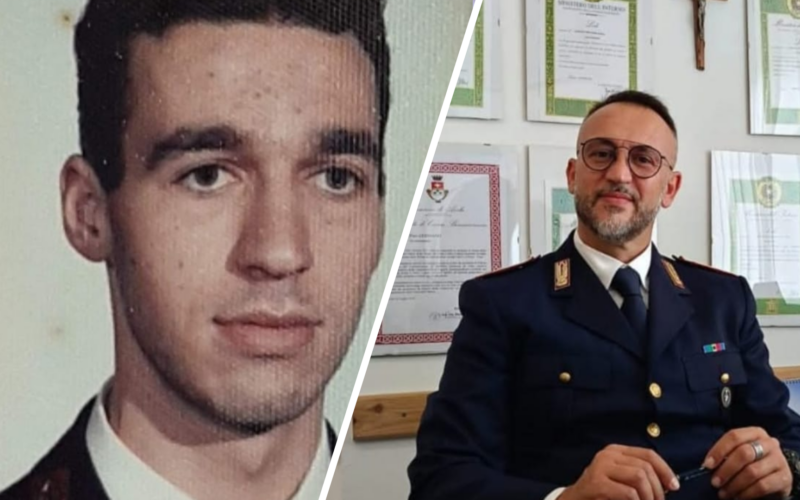
Avola – There are stories worth passing down because they tell not only the professional paths of two men, but also their bond with a city, a family and a tradition of service. This is the story of the Germano brothers, united by family ties and the National Police (Polizia di Stato), yet with very different personal journeys: Silvano, remembered for his talent in communication and poetry, and Pino, who dedicated 32 years of his life to serving the state.
Silvano Germano, from radio to uniform, without ever forgetting poetry. In memories of Avola’s cultural life in the 1980s, Silvano stands out as a multifaceted figure with a marked gift for communication. Before joining the police, he had made a name for himself as a radio presenter and host of public events. According to family accounts, from the stage set up in Avola’s main square he introduced nationally famous artists such as Toto Cutugno and Anna Oxa, alongside other leading figures of Italian music at the time.
His personality, however, was not limited to his ability to command a stage and entertain an audience. Silvano also cultivated poetry, writing several pieces and taking part in literary initiatives. Family memories recall that in the 1980s he received an award as a young poet in Fiuggi, an episode that deserves further documentation through the prize archives or the chronicles of the day.
This sensitivity to words and culture is traced by the family to the influence of his maternal grandfather, Professor Enzo Alia, remembered as a journalist active in the 1950s, 1960s and 1970s. A cultural legacy that, in the memory of those close to him, helped Silvano develop a love of writing, communication and engaging with the public.
The history of Radio Sicilia Avola also preserves a trace of his name: Silvano Germano appears in a reconstruction dedicated to the local station’s story. It is a reference that helps place him in the city’s social and cultural landscape, alongside the personal memories of those who knew him.
Later, Silvano joined the National Police and served with the mobile unit in Catania. His life was tragically cut short in 1990 when he died in a road accident between Modica and Ragusa. According to family testimony, three young people died in the crash. At the time, Silvano was not on duty: he was spending his free time with friends. The precise dynamics of the accident, the names of the other victims and the documented circumstances of the tragedy remain to be reconstructed from the chronicles of the day.
Memory restores the image of a young man whose life encompassed many facets: the police officer, the radio host, the presenter, the poet and the friend. His premature death left a void in the family and among all who had known him. Beyond private memories, there remains a desire to preserve and value that part of his life that had made him a recognisable presence in the Avola community.
Pino Germano, 32 years of service in the National Police. His brother Pino’s professional story, by contrast, unfolded over more than three decades of investigative work. Now a chief superintendent in the National Police, Pino has completed 32 years of service, 27 of them in judicial police work. His career, based on the professional information he provided, has taken him through various offices in the province of Syracuse and included operational experience in complex investigative contexts.
In the 1990s he served with the Flying Squad in Syracuse, in investigative work he recalls as particularly demanding. In the early 2000s he worked with the judicial police unit in Pachino, then for several years in the equivalent office in Noto. In recent years he has served at Avola police station, focusing in particular on anti-crime activities and gender-based violence, with specific attention to violence against women and interventions under Italy’s fast-track procedure for domestic and gender-based violence (Codice Rosso).
During his career, according to his own account, he has taken part in investigations that helped combat mafia-style organisations, drug trafficking and dealing, and criminal activities linked to fraud, robbery and extortion. In Pachino and Noto he also participated in investigations into serious violent crimes, including murder cases. These are experiences that require preparation, powers of observation, knowledge of the area and collaboration with other officers and the judiciary.
Pino also reports receiving commendations from the National Police for his work and for rescue interventions in particularly delicate situations, including helping vulnerable people at risk of self-harm. These are episodes that recall a fundamental dimension of police work: not only combating crime, but also stepping in to protect life, offering help and safeguarding people going through moments of extreme fragility. For a complete biographical reconstruction, the individual commendations and interventions could be further specified through the relevant official documentation.
Two brothers, two paths and a memory that endures. Silvano and Pino’s stories recount two different ways of being part of the same community. Silvano, through radio, the stage and poetry, had built a relationship with Avola’s cultural life before putting on the uniform. Pino developed a long career in the National Police, above all in investigation, tackling crime and, more recently, delicate issues such as gender-based violence.
It is important to distinguish what emerges from published sources from personal memories and family testimony: the traces of Silvano’s presence in the history of Radio Sicilia Avola and the available information on Pino’s career constitute starting points for a broader reconstruction. The episodes relating to the evenings hosted by Silvano, the poetry award in Fiuggi, the dynamics of the 1990 accident and Pino’s individual professional interventions could be explored further through testimony, documents and archives.
Telling this story therefore means preserving a family and civic memory, without confusing the value of memories with historical verification. It means remembering Silvano not only for his tragic end, but also for the talent, creativity and presence he expressed during his life. And it means recognising in Pino the journey of a man who, through 32 years of service, made the National Police a central part of his professional experience.
Two brothers, two different stories, united by family, by their bond with Avola and by service to the state. A memory that deserves to be preserved and told with respect, precision and attention to the truth.