Translated automatically by AI from the Italian original.
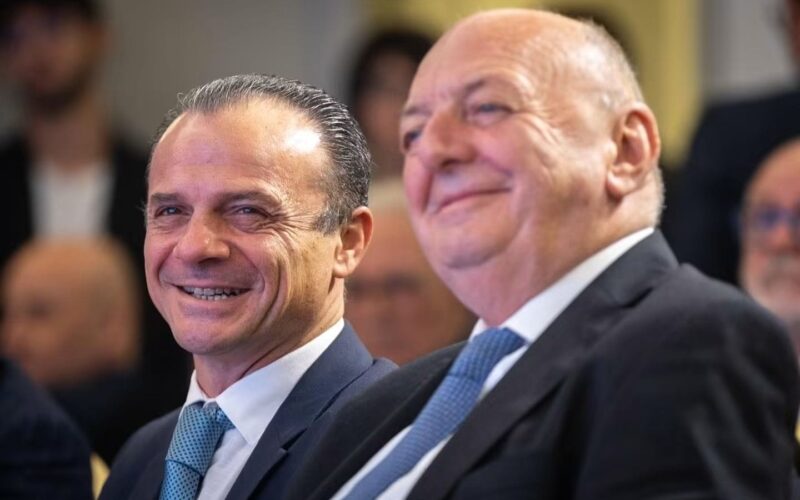
ROME – Bringing the needs and experience of local administrators to the heart of the national political agenda. The summit promoted by Sud chiama Nord and Sindaci d’Italia entitled “L’Italia dei Territori” has begun in Rome, a three-day institutional debate aimed at laying the foundations for a new political proposal based on pragmatism, autonomy and the central role of local authorities.
The opening speech was given by the president of Sindaci d’Italia, Ernesto Magorno, who reiterated the ideal basis for the federation process with the party led by Cateno De Luca:
“Sud chiama Nord is a party of the territory, of mayors and of local administrators. It is a party of the territories, and it is natural to federate with those who share our same history. This is not a backroom operation, but a project rooted in the teachings of Don Luigi Sturzo.”
During the morning, the Minister for the Environment and Energy Security, Gilberto Pichetto Fratin, also spoke, addressing the issues linked to high energy prices, new-generation nuclear power and the role of the Mezzogiorno in infrastructure corridors. In response to a question about the new political landscape, the minister expressed appreciation, describing collaboration with Sud chiama Nord as “a remarkably realistic contribution” to the coalition.
De Luca: “From finance to bureaucracy, here is the administrative method”
Particularly detailed was the contribution from Cateno De Luca, who took on the role of “facilitator” with the aim of reaching a national strategic and programmatic synthesis between the two movements:
“The first thing I have always done on entering a town hall is to ask for the budget. Because the budget is not just about numbers, but the political choices that need financial backing. The excuse that we are at the mercy of bureaucracy must end: the strategic direction on organisation lies with the mayor and the municipal executive.”
Reviewing more than 20 years of administrative battles – from his experiences in Fiumedinisi, Santa Teresa di Riva and Messina to his current leadership of the city of Taormina – De Luca underlined the substantial difference between authority and authoritativeness: “Authority is granted to us by the law. Authoritativeness is what we earn for ourselves in the field: I prefer to be authoritative, not authoritarian.”
Programmatic proposals for the country
The former mayor of Messina then translated his administrative experience into a series of concrete proposals intended to feed into the national programme:
- Integrated territorial planning: promote simplification models (along the lines of the “Vivi Fiumedinisi” plan) to unify public and private investment, urban regeneration and job creation in a single procedural pathway.
- Revenue from archaeological sites: extend nationwide the model already introduced in Taormina, guaranteeing the local councils that host major cultural attractions a share of ticket sales revenue to be allocated to upkeep, cleaning and security.
- Reform of financial distress: revise the legislation on local authorities to free councils that are capable of restoring their finances ahead of schedule from the restrictive legal constraints.
Accompanied by screenings of historical videos of his headline-grabbing actions in the field, De Luca dismissed the “sheriff mayor” label with candour: “Sheriff-style stunts that are an end in themselves achieve nothing. What matters in the end are the results.” The event will continue over the coming days with the announced participation of senior institutional figures including the President of the Senate Ignazio La Russa, several ministers and the Prime Minister Giorgia Meloni.