Translated automatically by AI from the Italian original.
ROME / TURIN – It was a day of intense social conflict and mobilisation across Italy, marked by the general strike called by grassroots unions (USB, COBAS, ADL, CLAP, SIAL and CUB) together with student movements and social centres. Their demands centred on tackling the cost of living, operational spending on rearmament, cuts to healthcare and education funding and recent repressive measures.
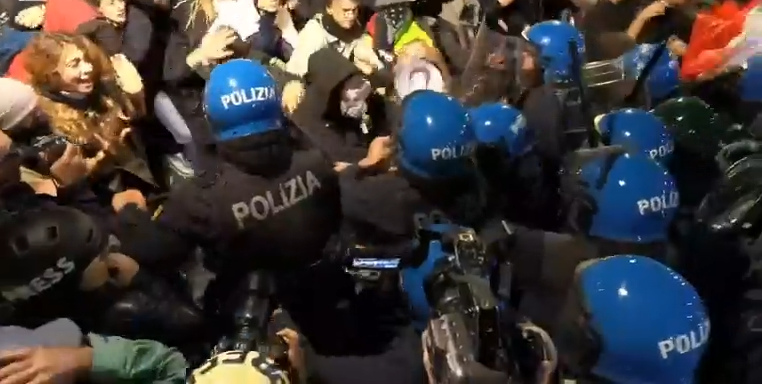
As protests filled the streets of more than 70 cities, the most acute tensions were recorded in Rome, where they erupted into direct clashes between demonstrators and police.
Rome: attempts to break through police lines and charges, eight detained
In the capital the situation deteriorated at several key points along the banks of the Tiber and at entrances to the historic centre. Multiple groups of protesters repeatedly tried to force their way past police blockades to reach the seats of power and parliament.
The most intense confrontations took place on Rome’s bridges:
- Ponte Sisto and Ponte Garibaldi: Police in riot gear carried out clearing charges, using shields to push back the advancing march.
- Piazza dell’Emporio and Circo Massimo: After a barrage of bottles, firecrackers and stones was thrown at security lines, police deployed water cannon to halt the assault and redirect protesters towards via Marmorata.
At the end of the day of clashes, the provisional tally from the authorities put the number of people detained for identification and checks at eight.
Reactions: Cobas celebrate as school strike data emerges
On the union front, the day was hailed as a strategic success by the organisers. Piero Bernocchi, a spokesperson for COBAS, gave a triumphant assessment and pledged further action:
“Today the huge turnout was driven by the social, economic and political conflict in our country, the cost of living, exorbitant energy prices, ‘more wages, fewer weapons’, and investment in schools and healthcare. Today’s success compels us to quickly set a date for continuing national mobilisation, and we are not ruling out another general strike soon.”
— Piero Bernocchi, COBAS spokesperson
On the specific issue of participation in the education sector, the provisional official figures released by the Ministry of Education and Merit (updated at 5pm, covering 54.73% of institutions) show a turnout of 7.57% among workers.
Transport row: transport ministry praises Salvini’s strike restrictions
Alongside the street protests, the government defended the countermeasures taken to limit the crippling disruption to citizens. The Ministry of Infrastructure and Transport (MIT) expressed strong satisfaction with how services had run:
“The decision by minister Matteo Salvini to impose strike restrictions helped safeguard the daily travel of millions of workers, commuters and citizens. Although there was traffic disruption linked to protests in some cities, the risk of a general paralysis of transport services was averted.”
— Ministry of Infrastructure and Transport statement
Turin: packed square and evening march
In the Piedmont capital, the mobilisation also drew thousands of protesters, organised by the Turin for Gaza committee and university students from the Campus Einaudi. After marching through the main streets under the banner “Every hub will be a barricade. We are not paying for war”, the protest continued in the evening towards the Giardini Reali and the Prefecture, without however descending into direct physical clashes.