Translated automatically by AI from the Italian original.
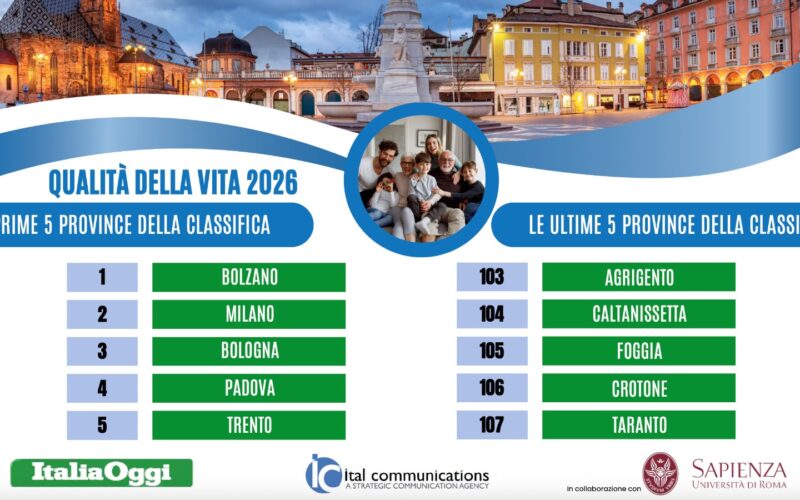
MILAN / NEWS & ECONOMY – Bolzano, Milan and Bologna take the podium in the 28th edition of the 2026 Quality of Life Survey of Italian provinces, produced by ItaliaOggi and Ital Communications in partnership with Sapienza University of Rome. Compared with last year’s ranking, there has been a change at the top: Bolzano displaces Milan to take first place thanks to its performance in the economic, environmental and tourism spheres, while the Lombard capital drops to second and Bologna remains stable in third.
The bottom of the table remains concentrated in the Mezzogiorno, with Taranto (107th) — down six places — in last position, preceded by Crotone (106th) and Foggia (105th). There is a slight improvement for the Sicilian province of Caltanissetta, which sheds last year’s wooden spoon by climbing three places to 104th.
[Image: Infographic of the 2026 Quality of Life ranking of Italian provinces]
The biggest climbers and falls: record for Belluno
Overall, quality of life in 2026 is good or acceptable in 60 provinces out of 107, the same figure as the previous survey, confirming a substantial national stability in medium-high living standards. Among the most significant movements this year:
- The biggest climbers: the absolute record goes to Belluno (31st), which has leapt 29 places since 2025. Pordenone, Venice, Ancona, Arezzo, Pistoia and Vibo Valentia have each gained at least ten places, joined by Rimini (6th), which has climbed six.
- The biggest falls: Monza and Brianza (9th), Ascoli Piceno (21st), Lucca (down 18 places), Cremona (down 16), Piacenza and Sassari (down 12, with the Sardinian city slipping into the insufficient-quality bracket) and Udine (down 10).
A country split in two and a focus on Sicilian provinces
The study — structured around nine analytical dimensions and five territorial clusters — confirms a clear geographical divide between the Centre-North and the South: the first southern province in the ranking is Isernia (67th), while the last northern one is Alessandria (72nd). The North-East remains the leading area, with all 22 of its provinces in the top brackets, whereas all 21 in the bottom group (insufficient quality) belong to the Mezzogiorno and the Islands.
In the individual thematic rankings, notable data also emerge for the provinces of Sicily:
- Business and work: Bolzano leads, ahead of Trento, Bologna, Padua and Cuneo. Agrigento (107th) brings up the national rear, down two places.
- Environment: Bolzano is first, followed by Bologna, Bergamo and Reggio Emilia. Catania has the national wooden spoon for environmental quality.
- Crime and safety: 62 provinces have good or acceptable levels. Potenza is first, followed by an excellent second place for Enna, ahead of Cuneo, Treviso and Ascoli Piceno. Trieste is last, while major metropolises such as Milan, Turin, Venice, Bologna, Florence and Rome struggle.
- Social security: the methodology has been revised with the introduction of the NEET indicator. Benevento is first (up from 50th), followed by Vibo Valentia, Prato, Ragusa (fourth in Italy) and Pistoia. South Sardinia is last.
- Education and training: Bologna is first, ahead of Milan, Udine, Trieste and Ascoli Piceno; numerous southern and island provinces, including those in Sicily, are at the bottom.
- Population: Bolzano takes its twelfth consecutive first place, ahead of Trento, Prato, Milan and Treviso; Ragusa is the only Mezzogiorno province in the leading group, while Oristano is last.
- Healthcare system: Ancona remains first, followed by Siena, Catanzaro, Pisa and Verona; South Sardinia is last.
- Tourism, entertainment and culture: Bolzano is first, ahead of Trieste, Rimini, Verona and Rome; the only southern representative in the leading positions is Naples, while Enna is last in the national ranking.
- Income and wealth: Bolzano leads, ahead of Milan, Bologna, Monza and Brianza and Ravenna; Crotone is last for the seventh consecutive year.
Comments from the research promoters
“The 28th edition of the survey confirms the persistent divide between the Centre-North and the Mezzogiorno. Bolzano, Milan and Bologna stand out for their services, infrastructure and opportunities, while many southern areas continue to record economic and social hardship. The challenge remains reducing inequalities and guaranteeing more opportunities and wellbeing for all territories,” observed Marino Longoni, deputy editor of ItaliaOggi.
“By analysing 107 Italian provinces across nine evaluation dimensions, the study provides a valuable body of information for both citizens and institutions. The survey is a useful tool for promoting transparent comparison between communities and administrators,” stressed Attilio Lombardi, founder of Ital Communications.
“The results confirm the presence of extensive areas of vulnerability in southern and island Italy. A broad-spectrum plan of interventions, with medium- and long-term objectives, is needed to bridge the gap,” concluded Alessandro Polli of the Department of Social and Economic Sciences at Sapienza University of Rome.