Translated automatically by AI from the Italian original.
14 municipal councillors have tabled a no-confidence motion against Syracuse mayor Francesco Italia: “The city is in a phase of serious decline”
From the “Nexus” judicial affair to delays on major administrative dossiers, from absences in the Municipal Council to issues with waste, water, urban planning and services: the motion has been filed. The signatories are calling for the mayor, Francesco Italia, to be summoned, asking the president of the City Council to convene a special session to discuss and vote on the document, in compliance with the procedures set out in current legislation.
The initiative, which involves members of Forza Italia, Fratelli d’Italia, the Democratic Party and the mixed group, is based on a series of political and administrative grievances. At the heart of the motion are the relationship between the mayor and the Municipal Council, the failure to implement several points of the election programme and the issues that have emerged in the context of the judicial investigation codenamed “Nexus”, coordinated by the European Public Prosecutor’s Office.
The signatories argue that the current administration has shown such limitations as to make a change of direction necessary for the city.
The legal framework and the numbers behind the no-confidence motion
In the document, the councillors cite article 52 of legislative decree 267/2000, Sicilian regional legislation and the provisions of the municipal statute and council regulations.
The motion recalls that, according to the signatories, at least 13 signatures are required to submit it and a qualified majority is needed for approval, identified in the document as 20 favourable votes out of 32 councillors.
If approved, the consequence would be the termination of the mayor, the municipal executive and the Municipal Council, with the start of the procedures provided for the renewal of the elected bodies.
The councillors also cite constitutional and administrative case law according to which the grounds for no confidence may also be predominantly political, when conflicts arise between the mayor and the city assembly.
The Nexus case and political grievances
A significant part of the motion is devoted to the “Nexus” judicial affair. The signatories refer to developments on 14 October 2026, when, according to the document, several precautionary measures were reportedly applied against entrepreneurs, a carabiniere serving at the Catania Public Prosecutor’s Office and the vice-president of the Syracuse Municipal Council, who was a member of the municipal executive responsible for a portfolio during Italia’s first term.
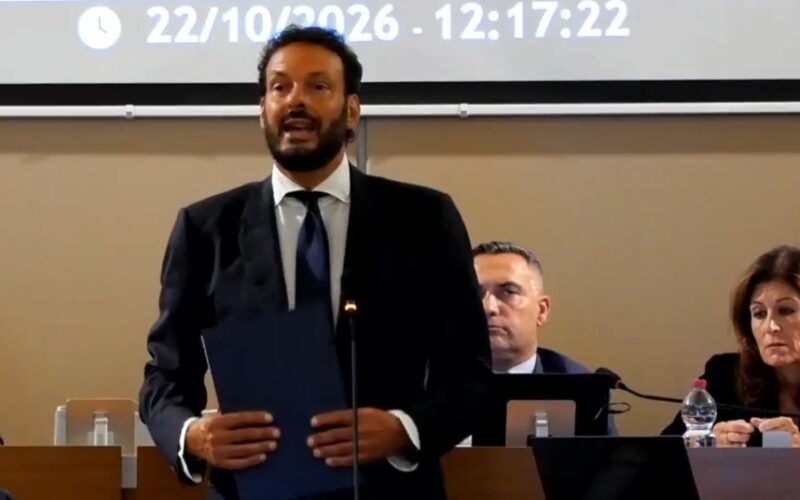
The councillors criticise the mayor for not providing what they considered adequate answers during the council session on 22 October, convened to examine the administrative aspects of the affair.
In particular, the motion refers to the anti-corruption audit plan provided for by the 2024–2026 PIAO, for which the signatories attribute political responsibility to the mayor. According to the promoters of the initiative, the session did not clarify the elements necessary to understand the functioning of internal controls and the measures adopted to prevent any irregularities.
The document also refers to work on the hostel for migrants in Cassibile. The councillors are seeking clarification on the award procedures, compliance with the principle of rotation in public contracts and the correspondence between the planned, funded and actually implemented works, including the photovoltaic plant provided for by the ACCA project.
The motion states that, in October 2025, the sole person responsible for the project formally informed the authority that they were under investigation. The signatories argue that, after this communication, more incisive administrative checks should have been activated.
The grievances contained in the motion represent the political assessments of the proposing councillors and do not, in themselves, constitute findings of criminal liability.
“Absent from the Council and inattentive to institutional dialogue”
Among the political reasons behind the no-confidence request, the signatories also cite the relationship with the Municipal Council.
According to the document, the mayor rarely attended council sessions, failed to implement the policy directives approved by the assembly and missed the monthly Question Time appointments, during which he should have directly answered the councillors’ questions.
They also criticise the failure to attend the council committees responsible for culture and sport, portfolios that Italia reportedly retained during his term, as well as the late transmission of important documents to the committees, often close to the deadlines.
For the promoters of the motion, these behaviours would have weakened the role of the council body and compromised the necessary institutional dialogue between the mayor and the representatives elected by the citizens.
Urban planning, waste, taxes and water: the administrative issues
The second part of the grievances concerns the implementation of the election programme and the management of the city’s main problems.
On the urban planning front, the councillors denounce the lack of concrete initiatives for the adoption of the new general urban plan, despite the need to update a planning tool that is now outdated.
On environmental matters, the motion criticises the failure to meet the targets for the pay-as-you-throw element of the municipal waste tax (TARI) and the persistence of issues in waste collection. The signatories also lament the absence of a significant reduction in local tax pressure, with rates that, according to the document, largely remain at the maximum permitted levels.
Among the other issues raised are traffic, the lack of parking, the management of blue lines and the prospects for entrusting services to private operators.
There is also criticism of the management of resources from the tourist tax, deemed insufficiently used to improve tourist services and expand the offer beyond the peak months.
Particular attention is paid to the water emergency, with service disruptions that, according to the councillors, continue to affect various areas of the city, and to the transfer of the water and sewerage service management from Siam to Aretusacque.
Cemetery, trade, culture and outskirts
The list of grievances also includes the saturation of the municipal cemetery and the condition of the structure. The signatories also recall the project for the construction of a crematorium, approved by the municipal executive in 2023 through a feasibility study, lamenting its lack of follow-up.
The motion also attributes to the administration an insufficient response to the crisis in trade and craftsmanship, the need to expand cultural activities throughout the year and the exodus of young people from the city.
Among the proposals that, according to the councillors, have not been adequately implemented, are public aggregation spaces, concert halls and artistic activity venues and places dedicated to study.
Finally, the signatories denounce a lack of attention to the outskirts and the former hamlets of Cassibile and Belvedere, with particular reference to the beach areas and Fontane Bianche.
“This administration must be brought to an end”
In their conclusions, the 14 councillors argue that the Municipal Council cannot continue to passively watch what they define as a phase of serious decline in the city. The “Nexus” affair, according to the promoters, has made the requests for clarification and political discontinuity even more urgent.
For this reason, they are calling for the convening of the council session dedicated to the motion and invite all other councillors to propose amendments or additions to the text, with the aim of reaching a shared decision.
The proposal has been signed by Alessandra Barbone, Andrea Buccheri, Cosimo Burti, Paolo Cavallaro, Damiano De Simone, Angelo Greco, Marco Greco, Salvatore La Runa, Leandro Marino, Massimo Milazzo, Paolo Romano, Daniela Rabbito, Simone Ricupero and Sara Zappulla.
The political challenge now moves to the Municipal Council: to turn the motion into an effective act, the convergence of the signatories alone will not be enough; it will be necessary to reach the number of favourable votes required by the regulations. The vote will therefore be a decisive step in verifying whether there is a council majority capable of bringing the current administration to an early end.