Translated automatically by AI from the Italian original.
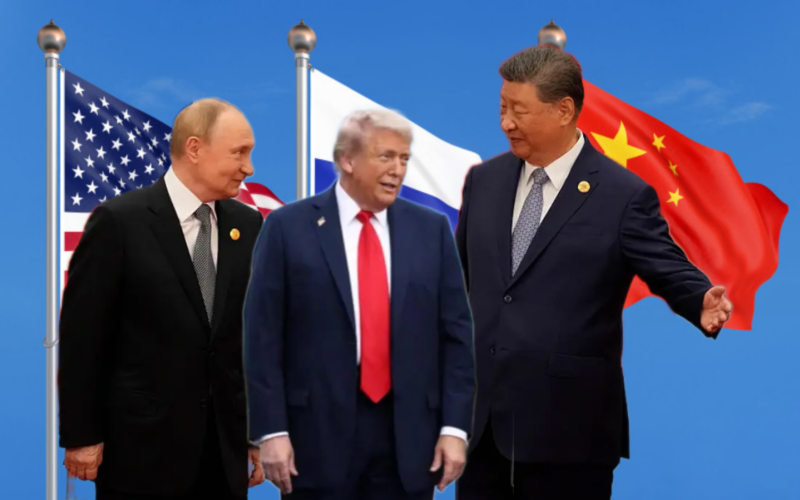
SHENZHEN (CHINA) / FOREIGN AFFAIRS & GEOPOLITICS – The announcement of a three-way summit between Vladimir Putin, Xi Jinping and Donald Trump, scheduled for Thursday 19 November 2026 in Shenzhen, has inevitably reignited historical echoes and immediate parallels with the great 20th-century conferences. The image of the three leaders around the same table has conjured the spectre of Yalta and a new carve-up of global spheres of influence; yet a precise analysis of the diplomatic preparations reveals a far more cautious scenario, distant from that iconography.
Official statements from the White House and the Kremlin — through the voice of spokesman Dmitry Peskov — in fact converge solely on the summoning of the meeting, which will take place on the sidelines of the 33rd meeting of Apec economic leaders, chaired by Xi Jinping himself. Nothing confirms the existence of pre-packaged political agreements: the agenda and format of the trilateral remain the subject of negotiation, demonstrating that the meeting opens a channel for dialogue but does not certify any prior overcoming of differences.
[Image: A view of the Shenzhen skyline, venue for the Apec summit and the US-China-Russia trilateral]
Nuclear arms: the asymmetry that blocks binding agreements
Even the dossier on nuclear arms control, often cited as the main strategic test of the three-way format, downplays the significance of the event:
- No imminent agreement: although Washington has expressed interest in a dialogue involving Beijing, a senior US administration official has already ruled out that any nuclear agreement could emerge in Shenzhen.
- The arsenal gap: the start of structured negotiations is hindered by the marked asymmetry between the forces involved, as China’s nuclear arsenal remains significantly smaller than those of the United States and Russia.
- The 2022 precedent: the last shared reference remains the joint statement by the five nuclear powers in January 2022 on the principle that a nuclear war cannot be won and must not be fought, which however lacked quantitative caps, verification mechanisms or binding disarmament timelines.
The Ukraine dossier and the diplomatic tracks already active
Similar caution dismisses the idea that Ukraine’s future will be decided in China, bypassing the directly involved actors. The Shenzhen meeting fits into a diplomatic path already underway on other tables:
- Direct talks: recent events include the Russian-Ukrainian bilateral meetings in Abu Dhabi on 10 and 11 November.
- US diplomatic shuttle: these were followed by the mission to Moscow of US envoys Jared Kushner and Steve Witkoff and the subsequent meeting with Volodymyr Zelensky, while the issue of European inclusion in the next negotiating rounds remains open.
Presenting the Chinese summit as a pre-defined peace conference would therefore mean attributing to the participants decisions that have neither been agreed nor announced.
The Apec multilateral framework and US-China sticking points
Finally, the institutional context in which the meeting takes place helps to dismantle the Yalta framework once and for all. Apec brings together 21 Asia-Pacific economies and operates through mechanisms of consensus and voluntary cooperation on trade, artificial intelligence, supply chains and economic resilience: the restricted dialogue among the three powers does not constitute a deliberative body of the forum nor does it have any mandate to bind the other member countries.
On the bilateral level between the United States and China, concrete and complex dossiers remain open — from Treasury Secretary Scott Bessent’s requests for macroeconomic rebalancing and increased agricultural purchases, to tensions over rare earths, critical minerals and trade restrictions. 19 November will therefore not mark the birth of a new carve-up order, but a first, measured diplomatic test in which the dialogue itself represents the starting point rather than the finish line.