Translated automatically by AI from the Italian original.
ROME / POLITICS – A significant tightening of social media use by minors is emerging in Italy’s legislative debate. The centre-right is set to table an amendment to the Security Decree – with the first signatory being the Chamber’s vice-president and Fratelli d’Italia MP Fabio Rampelli – that would redraw the rules on access to digital platforms for children and adolescents. The proposal, which has won the support of the education minister Giuseppe Valditara, introduces strict age limits and extended parental controls.
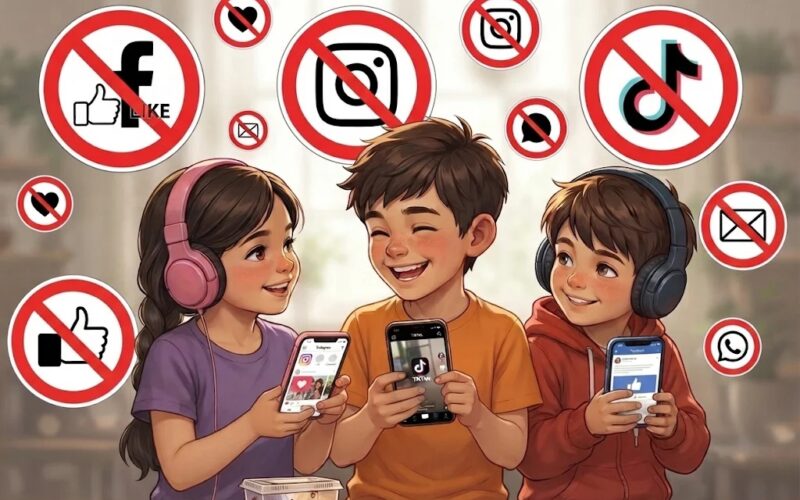
[Image: Smartphones and digital devices used by young people and adolescents for social media browsing]
The three pillars of the crackdown: bans, links and autonomy
The draft legislation outlines three distinct age brackets for managing social media profiles:
- Under 13: Absolute ban on signing up to platforms.
- 13 to 16: Access allowed but with a requirement to keep the account strictly linked to that of a parent or guardian.
- 16 and over: Ability to open and manage a profile independently.
For now this is a political proposal at the presentation stage, not an obligation already in force for families or social media operators. To understand its real practical impact, it will be crucial to analyse the technical wording of the amendment, particularly regarding the practicalities of supervision and the handling of existing profiles.
The privacy issue and the current legal framework
The measure opens a wide-ranging debate on the current privacy and digital consent rules. The data protection authority points out that in Italy minors can give their own consent to data processing for digital services from the age of 14, while below that threshold parental authorisation is required – a principle that until now has not amounted to a general ban on signing up.
The new proposal shifts the regulatory axis by introducing a structural restriction on account autonomy up to the age of 16, partly reviving the parliamentary debate already begun in recent months through similar initiatives tabled in the Chamber and Senate by Mara Carfagna and Mariastella Gelmini.
Comparison with the European Union and the age-verification challenge
The issue fits into a complex international context. At EU level, the European Commission is working on the KIDS Act (a proposed regulation that would ban social media for under-13s, require supervised accounts for 13–14-year-olds and allow autonomy from 15), highlighting a partial divergence from the 16-year threshold chosen in the Italian initiative.
There is also the central technological issue of age verification. The guidelines published by Brussels in July 2025 under the Digital Services Act recommend the adoption of accurate, non-invasive tools capable of blocking access to unauthorised minors without collecting a disproportionate amount of personal data. Alongside age limits, the European debate also insists on the need to impose “by design” safety rules on platforms: private accounts by default, protective algorithms and limits on mechanisms that encourage continuous use.