Translated automatically by AI from the Italian original.
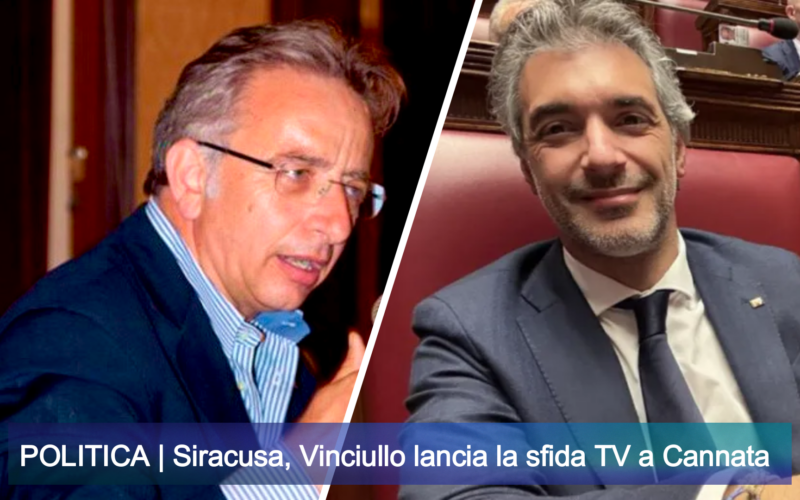
SYRACUSE / POLITICS – A new chapter has opened in the political clash within Syracuse’s centre-right. Vincenzo Vinciullo, provincial coordinator of Grande Sicilia, has replied again to Luca Cannata, the national MP for Fratelli d’Italia, after Cannata’s counter-proposal to extend a potential televised debate to include Giuseppe Carta, a member of the Sicilian Regional Assembly, and the mayor, Francesco Italia. According to the autonomist figure, this is a ploy to avoid a direct confrontation.
[Image: Palazzo Vermexio in Syracuse]
Accusations of refusing debate and solidarity with Annino
In his statement, Vinciullo accuses the FdI MP of preferring controversy in the press and on social media to a public face-to-face meeting:
“When faced with direct political debate, when it becomes necessary to look your political opponents—whom he sees as personal enemies—in the eye, Cannata sheds the mantle of Richard the Lionheart and reveals the courage of Don Abbondio, always finding a reason to back out and hide. He refused the public debate I invited him to, to end this quarrel, because he lacks the courage to back up what he has said.”
The Grande Sicilia coordinator also addressed a message to Antonio Annino, a collaborator of Cannata’s who was mentioned in the Avola MP’s previous reply: “I wish to express my full solidarity with Antonio Annino, my brilliant former pupil, who has been inappropriately and unfairly dragged into this affair.”
Reference to Canicattini Bagni and the end of the row
In his remarks, Vinciullo then shifts focus to the internal balance within Fratelli d’Italia in the province of Syracuse, citing the move by a municipal councillor in Canicattini Bagni to the mixed group and arguing that attacks on allies are a way to distract from the party’s organisational difficulties.
“It is pointless and tedious to keep dragging Giuseppe Carta into this: Cannata has already lost every confrontation with him. Instead of continuing to attack others, Cannata should stop, admit his mistakes and carefully reread the list of Fratelli d’Italia’s defeats and defections for which he is chiefly responsible.”
In closing, the former member of the Sicilian Regional Assembly declares that he considers the long-distance exchange of barbs over: “Since Cannata has refused the public debate, trotting out the usual trivial and whining excuses, I no longer intend to waste time on him or pursue a row that has now become a personal matter.”