Translated automatically by AI from the Italian original.
CATANIA – Moving from fragmented emergency management to a structured, aware culture of prevention is the central goal of “Beyond the emergency – Governing land instability: from crises to prevention”, a national-level event that from 12 to 14 November will turn the Le Ciminiere complex in Catania into Italy’s reference point for safety and land protection.
The event is promoted by the Minister for Civil Protection and Sea Policies, Senator Nello Musumeci, and by Casa Italia, the department of the Presidency of the Council of Ministers, and is co-organised by the University of Catania together with the Metropolitan City of Catania. Over fifty speakers, including institutional representatives, national experts, academics, technicians and special commissioners, will take part in a packed programme of conferences, round tables and training sessions.
The scientific research serving public decision-making
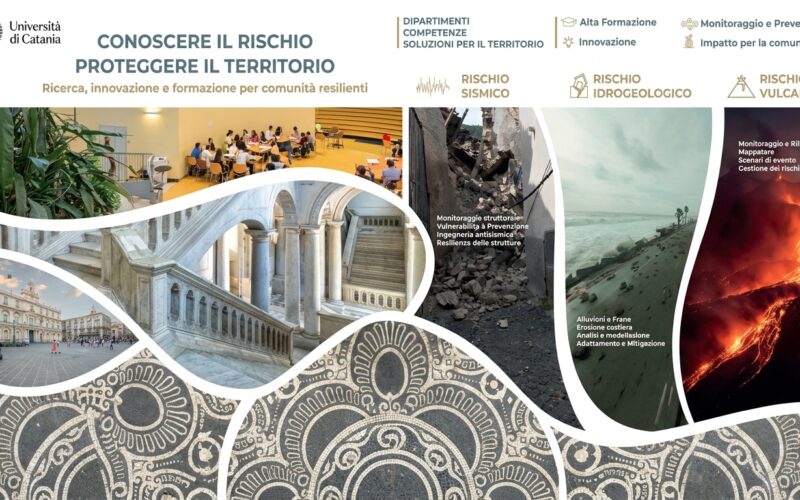
The University of Catania will be one of the central pillars of the initiative, setting up a large exhibition stand dedicated to applied research projects conducted by its leading departments (Di3A, Dsbga and Dicar).
- The Rector’s words: “Hydrogeological instability, seismic and volcanic vulnerability and coastal erosion require advanced detection tools, predictive models and land planning,” said the rector Enrico Foti. “The value of this initiative lies in strengthening the operational link between research, institutions and businesses, so that science translates into tools to support public decision-making and into effective policies to reduce vulnerability.”
From green roofs to anti-seismic sensors: the projects on display
In the exhibition areas at Le Ciminiere, the results of numerous cutting-edge research projects will be presented, ranging from local to international scenarios:
- Hydraulic engineering and nature-based solutions: Di3A will showcase the effectiveness of the 900 m² green roof built on the Bioscience Hub (capable of retaining up to 70% of rainfall and reducing peak flows) and the 4,400 m² rain garden at Tondo Gioeni. On the Alcantara river, at the Cottanera and Passo Moio sites, the restoration of floodplain areas has made it possible to recreate wetlands that regulate river flow and protect biodiversity.
- Seismic monitoring and infrastructure: Dicar will illustrate technologies for real-time monitoring of the roofing at Fiumicino’s Cargo City and experiments on the vulnerability of historic centres and ancient bridges. Among the projects, devices for absorbing seismic energy, the study on materials derived from Mount Etna’s ash and the use of artificial intelligence for observing the Melbourne volcano in Antarctica also stand out.
- Coastal erosion and advanced geophysics: The Hydraulics and Coastal Engineering Group, with the REST-COAST, WETWISE and MARCUS projects, presents interventions for the restoration of dunes and Posidonia meadows in the marshes of south-eastern Sicily. At the same time, the Geophysics group of Dsbga will show how it transforms microseismic and infrasonic signals into early warning tools to prevent storm surges and Mediterranean cyclones (WAVEGUARD and SEIS-STORM).
The experts’ contributions: Etna risk and urban planning
In addition to the exhibition presence, Unict academics will bring high-level scientific contributions to the debate sessions:
- Coastal erosion: Professor Rosaria Ester Musumeci will highlight the need for a hybrid approach to coastal defence, combining structural interventions with renaturalisation and soft nourishment in the face of the increasing number of extreme events and Medicanes.
- Urban planning and safety: Professor Paolo La Greca (President of the National Centre for Urban Studies) will stress that “when an emergency becomes stable, it must be treated as ordinary: territorial safety is a shared task that requires integration between urban planning and active community participation.”
- Volcanic risk: Professor Marco Viccaro (President of the Italian Association of Volcanology) will outline the updated picture of Mount Etna’s hazard, focusing on the risks associated with lava flows from flank eruptions and recalling the need to spread a constant culture of risk among the population.