Translated automatically by AI from the Italian original.
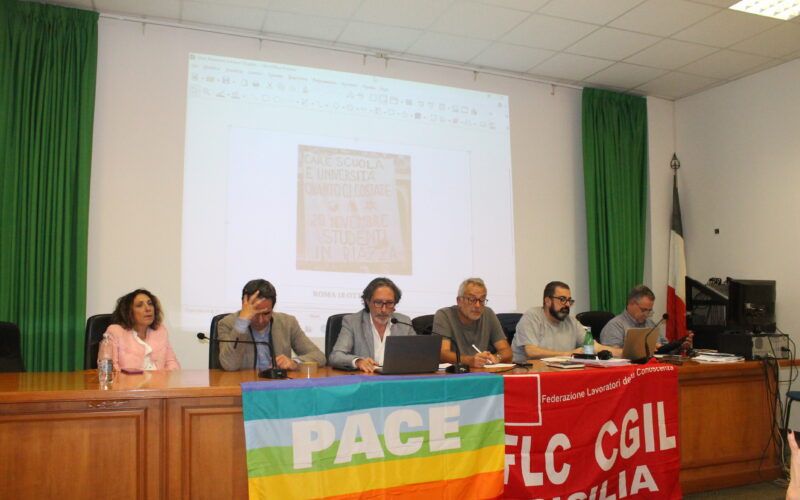
The reasons for the CGIL general strike on 20 November, the state of public education and the political, economic and social situation were the topics addressed by the general assembly of FLC CGIL Sicily, held yesterday in Palermo with union leaders from every province of the island.
At the heart of the report by Adriano Rizza, general secretary of FLC CGIL Sicily, was the need to step up mobilisation against the policies of the Meloni government, which continue to fuel social inequality, precarious work, falling wages and the gradual weakening of public services.
“The strike on 20 November is not a mobilisation that concerns only the world of work, but speaks to the entire country: to young people, pensioners, the precarious, women, students, to everyone who sees their rights and opportunities shrink every day. It is not enough to share the reasons for the strike: we must take them into workplaces, schools, universities, communities and turn them into a great collective participation,” Rizza said.
Particular attention was paid to the dire situation in Sicily, where demographic decline, depopulation and growing poverty are seriously jeopardising the future of the next generation.
“The figures describe a region in deep difficulty. According to the 2026 Svimez report, 44% of Sicilian households are at risk of poverty. Between 2018 and 2025, schools on the island have lost almost 160,000 pupils, and in the last year alone more than 12,000 young people under 35 have left Sicily to move north or abroad. It is a social and demographic haemorrhage that should demand radically different political choices,” he said.
For FLC CGIL Sicily, the response from the institutions cannot be to use the fall in the school population to justify further cuts to teaching and non-teaching staff, the resizing of schools and the weakening of the educational offer.
“Fewer students,” Rizza explained, “must not mean less school. On the contrary, it should be an opportunity to reduce class sizes, expand full-time education, strengthen staffing, tackle early school leaving and finally guarantee equal educational opportunities across all parts of Sicily. School cannot be seen as an expenditure to be cut, but as the main investment to counter depopulation and build the island’s future.”
During the assembly, strong concern was also expressed about the regional political situation. “While thousands of Sicilian families face growing economic hardship, while young people continue to leave and public schools suffer cuts, the regional political debate all too often seems focused on power balances and the distribution of resources without proper planning. Sicily needs a politics capable of addressing social emergencies, not a fragmented and clientelist management of public spending,” Rizza stressed.
“The challenge we face,” concluded the FLC CGIL Sicily secretary, “is to turn social hardship into participation, resignation into mobilisation and protest into a concrete demand for change. Young people must be the protagonists of this process. The general strike on 20 November represents a fundamental step in building a fairer society, founded on work, knowledge, peace and equal rights.”