Translated automatically by AI from the Italian original.
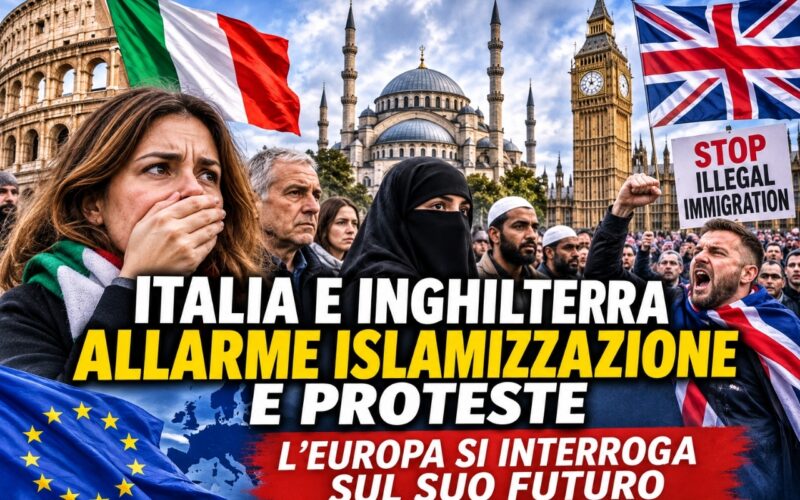
Europe is questioning its future
Between security, cultural identity, religious freedom and popular protests, the issue of the Islamic presence and integration is back at the heart of the European debate.
Europe is going through a particularly delicate phase. In several countries, the confrontation over immigration, the presence of Muslim communities, security and the ability of states to uphold their own laws, traditions and constitutional values is growing.
Italy is no exception. In recent months, political debate has intensified, with increasingly distant positions on the spread of Islamic places of worship, the use of the full veil in public spaces, integration in schools and the need to counter every form of religious radicalism.
Yet the question many citizens ask is a legitimate one: to what extent can a country welcome new cultural and religious communities without compromising its own identity and social cohesion?
Italy: between integration and fears of cultural transformation
The Italian government has recently adopted measures on schools, language integration and the full veil. The school decree of September 2026 introduced limits on the concentration of pupils with insufficient Italian language skills in classes and a ban on the burqa and niqab in schools.
The political debate has also grown more heated. The League has announced new initiatives against what it calls Islamic integralism, while Brothers of Italy has launched a campaign on women’s freedom and transparency in funding for places of worship.
On 23 November, Matteo Salvini announced a national mobilisation scheduled for 12 and 13 December against political Islam and Islamic radicalism.
These are issues that cannot be dismissed with simple slogans. Freedom of religion is a fundamental right, but no religion, organisation or ideology can claim to stand above the laws of the state.
England: streets fill with protesters
The situation in the United Kingdom has also become particularly delicate.
In recent months, several English cities have seen demonstrations against immigration and against government policies on welcoming asylum seekers.
On 16 May 2026, London hosted two large, separate demonstrations: one against high levels of immigration and what some protesters see as an Islamic threat to British identity, the other in support of the Palestinian people. The police deployed about 4,000 officers and made 31 arrests.
In October, protests against the reception of migrants were also held in Gosport and Portsmouth. In Gosport, on 25 October, about 400 people took part in an anti-immigration protest, while another group organised a counter-demonstration.
In Crowborough, Sussex, protests against the use of a military camp to house asylum seekers have dragged on for months, fuelling tensions between residents, local authorities and political movements.
It is clear that part of the British population is expressing growing discontent. However, citizens’ concerns must not be confused with the positions of extremist groups that fuel hatred and intolerance.
The problem is not faith, but radicalism
A fundamental distinction must be made: Islam, as a religion, cannot be automatically identified with terrorism, fundamentalism or political extremism.
There are millions of Muslims living peacefully in Europe, working, respecting institutions and contributing to society.
The problem arises when someone tries to impose religious rules incompatible with democratic principles, denies equality between men and women, justifies forced marriages, restricts individual freedom or fuels hatred towards those of a different faith.
On these behaviours, there can be no ambiguity.
Religious freedom must be protected, but it must go hand in hand with respect for the law, human dignity and fundamental rights.
At the same time, we cannot allow the fear of Islamisation to become a justification for indiscriminately discriminating against an entire religious community.
A Europe that must not be afraid to discuss
Europe must find the courage to tackle these issues without censorship, without intimidation and without turning every criticism into an accusation of racism.
Defending one’s cultural identity does not mean hating others. Defending Christianity, national traditions, history and Western values does not mean denying anyone the right to practise another religion.
It means, rather, recognising that every society has the right to protect its cultural heritage, provided it does so in accordance with the constitution and the rights of all.
Italy and England today represent two important vantage points for an issue that concerns the entire continent.
Institutions must guarantee security, controls, real integration and respect for the rules. Religious communities must work with states and isolate every form of radicalism. Citizens must be able to express their concerns without being criminalised.
The final question: what kind of Europe do we want to leave our children?
We cannot ignore what is happening in our cities, but neither can we build the future on fear and hatred.
Europe has a history, a culture and deep roots. It has a duty to preserve them, just as it has a duty to guarantee dignity and freedom to every person living on its soil.
The real challenge is not to set one religion against another. It is to prevent any form of extremism, religious or ideological, from threatening civil coexistence.
Because a democratic state must not give up its identity to welcome others, but neither must it give up its principles to defend it.