Translated automatically by AI from the Italian original.
A French newspaper interviews protesting students
We are not tired at all. More than a month and a half after the student movement began, young French people are still mobilised, but their mental health is suffering. Report from the Paris march.
“The general context is pretty depressing; when we look to our future, we can’t see much there at all.” In a few words, Clarisse, 19, sums up the feeling of a whole generation. Having come to protest under Paris’s grey sky this Tuesday, she stresses that the social mobilisation shaking the country for a month and a half was born of widespread unease among young people.
Young French people are particularly affected by mental health problems: a third of those aged 11 to 24 show signs of anxiety or depressive disorders. After several weeks of protests, some young demonstrators admit the movement is taking a psychological toll on them.
“We don’t know where we’re going”
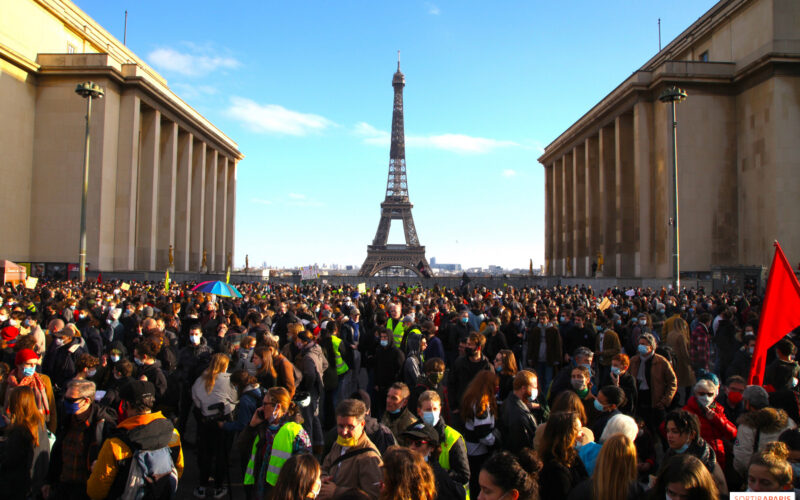
The march has not even started when it begins to rain on rue Soufflot, in the elegant, highly touristic 5th arrondissement of Paris. Secondary school pupils, university students and teachers have gathered to denounce, once again, the conditions in which learning and teaching take place, continuing the movement that began in September. Behind them looms a Panthéon shrouded in mist.
Clarisse, a student at the Sorbonne, admits: “Studying at the moment is extremely difficult. On the one hand, you have to take part in the protests; sometimes lessons are held remotely, other times there’s nothing at all. It all generates anxiety: we don’t know where we’re going.” Beside her, her friend Colombe adds: “For young people, this is a difficult time. A high school diploma doesn’t guarantee a place on a bachelor’s degree, a bachelor’s doesn’t guarantee a master’s, and a master’s doesn’t guarantee a job. I work hard, I get good grades, but I don’t know if it will all pay off in the future. I feel like we’ve been left to fend for ourselves a bit.”
In the march, this uncertainty about tomorrow is a widely shared feeling. “We don’t need tear gas to make our future unclear,” reads a huge banner. For Raven, this is a fear that adds to many others. “What causes anguish is the fact that the government isn’t listening to us,” observes the student, who is enrolled on a theatre degree course and is also worried about how exams will be conducted. Having protested for weeks, he admits to often feeling stressed and having trouble sleeping: “The uncertainty turns into anxiety and, for those who are already psychologically fragile, the situation becomes even more complex.”
“I still have nightmares”
Holding a placard, Nathanaël, 15, does not care much about grades. “A couple of zeros on my report card certainly won’t change my future,” the student insists. What really ties his stomach in knots is, above all, police repression. And not without reason: his first protest was far from a walk in the park. “I was hit by tear gas and a grenade landed right next to me. Later, I watched the Arte documentary on public order policing: it gave me chills.” Today he says he has toughened up. “But when it’s my mother going to protest, I’m not at ease,” the teenager admits.
“We started under the sign of trauma,” Emma, a student at the Sorbonne Nouvelle, comments with irony. Together with three friends, she had been attending a general assembly organised on 5 October by her university to join the student movement from secondary schools. A gathering that, according to the students and teachers present, was violently suppressed by the police; witnesses also report being trapped in a kind of “pocket” (a technique known as nassage) for several hours.
Once the subject is broached, the four young women cannot stop talking, visibly still in shock over what happened. The episode, among other things, reactivated a post-traumatic stress disorder from which Adèle had already been suffering. “I had to go back to my mother, who doesn’t live in Paris, and for two weeks I only went out to go to protests. I wasn’t able to do anything at all. I still have nightmares; it’s an unbearable situation,” the student recounts.
“The struggle helps improve mental health”
For Victoria, a third-year Spanish student, the mobilisation and its effects on mental health are a constant presence: “It’s a continuous succession of fear, tears and exhaustion.” What particularly disturbs her are the public order operations: helicopters in the sky, riot police units, protesters suffering mutilations… “On phones, on TV, on social media, that’s all you see,” she observes. “Even when we’re not at a protest, we see police everywhere.”
“We think about it continuously. We no longer have a life outside of all this,” adds Emma, who is also deeply involved in the movement and everything that has stemmed from it since the end of September. The student admits she has sometimes looked for excuses not to take part. But then the guilt sets in: “When you’re not there, you still feel bad for not having come. I couldn’t go to the protest on the 24th and I felt guilty.” For her part, Anaïs sums up the situation: “We force ourselves to come, but it’s an ordeal.”
To cope mentally, “we seek comfort wherever we can,” Emma explains. “I have friends who rewatch the TV series they loved when they were 12,” she observes, almost surprised. She admits her relationship with the mobilisation is sometimes paradoxical: while the social context is a source of anguish, on the other hand “the struggle helps improve mental health.” A feeling shared by all the young people interviewed by 20 Minutes, who explain that the reason they continue to mobilise is that they still have hope.