Translated automatically by AI from the Italian original.
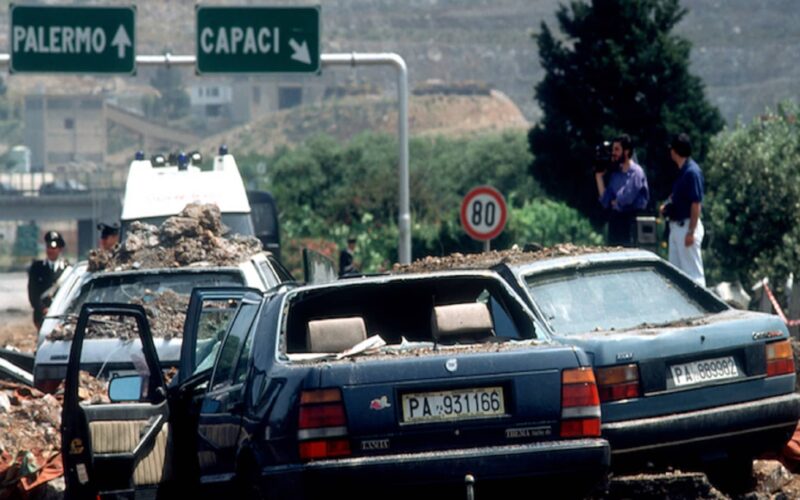
CALTANISSETTA / PALERMO / JUSTICE – The scenarios tied to the 1992 massacres and the investigation by the Caltanissetta Public Prosecutor’s Office – led by chief prosecutor Salvatore De Luca – are back at the centre of judicial and historical debate. The inquiry has placed the former police chief and former head of the DIS Gianni De Gennaro under investigation for alleged obstruction of justice (Article 375 of the penal code), aggravated by aiding Cosa Nostra, in connection with the via D’Amelio bombing and the disappearance of Paolo Borsellino’s red diary. Vincenzo Musacchio, a lecturer in strategies to combat organised crime and an associate of the Rutgers Institute on Anti-Corruption Studies (R.I.A.C.S.) at Rutgers University, comments on the issues emerging from the investigation and the order issued by the preliminary investigations judge Giulia Zappalà.
[Image: The Palace of Justice in Caltanissetta]
The judge’s order and the hypothesis of a “control room”
In discussing the preliminary investigations judge’s ruling – which, while not finding grounds for arrest, referenced “new perspectives on the context and the possible ‘control room’ behind the 1992 massacres” – Musacchio highlights the distinction between precautionary measures and the investigative phase:
“Acknowledging that the investigation opens new perspectives on a possible ‘control room’ means legitimising the line of inquiry that looks beyond the purely military level of Cosa Nostra. When we talk about events leading up to the massacres – from Salvatore Contorno’s clandestine return to the Addaura attack, through the season of the ‘crows’ to the disappearance of Paolo Borsellino’s red diary – we are reconstructing a network of deviations and cover-ups that, according to the prosecution’s hypothesis, could not have been managed by men of honour alone.”
According to Musacchio, a destabilising attack of this magnitude could not have been carried out without external collusion, recalling Giovanni Falcone’s investigative method based on the analysis of financial flows and the connections between the mafia, politics and the economy.
Grey areas, external masterminds and institutional tensions
Focusing on the dual track contested by the Caltanissetta magistrates – declaratory obstruction (linked to pressure on Salvatore Contorno) and material obstruction (concealment or destruction of documents) – and on the historical role of figures such as De Gennaro and the late Arnaldo La Barbera during the maxi-trial, Musacchio points to the complexity of the period between 1988 and 1992, marked by possible overlaps between the handling of informants, institutional balances and careerism.
As for the relationship between the maxi-trial and the theory of external masterminds, Musacchio believes the two interpretations are not in conflict:
“I do not believe that the hypothesis of external masterminds or converging interests disproves the ‘Buscetta theorem’ and the framework of the maxi-trial; in fact, I think it complements them. The maxi-trial demonstrated that Cosa Nostra was a hierarchical and unified entity, capable of deciding on major crimes internally. The 1992 and 1993 massacres, however, have a subversive scope that goes beyond the classic mafia strategy.”
At the same time, Musacchio warns against the risks arising from conflicts between prosecutors’ offices, political controversy or interpretations framed as score-settling between state bodies, recalling that criminal responsibility always remains individual.
Giovanni Falcone’s legacy and the search for truth
Finally, on the impact the investigation may have on the memory of Giovanni Falcone, who considered De Gennaro a trusted collaborator in handling Tommaso Buscetta, Musacchio rules out any diminishment of the magistrate’s stature:
“Giovanni Falcone’s legacy is not in the least diminished by the establishment of the truth, whatever it may be. If someone, without his knowledge or at a later time, acted according to different logic or betrayed that mandate, this does not diminish the moral and professional stature of a magistrate of Giovanni Falcone’s calibre. On the contrary: shedding full light on what really happened between Addaura and via D’Amelio is the only way to truly honour his memory and that of Paolo Borsellino.”