Translated automatically by AI from the Italian original.
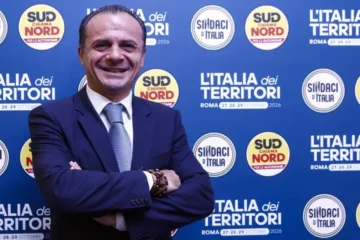
Rome has hosted the opening of the national convention of Sud Chiama Nord and Sindaci d’Italia, “L’Italia dei Territori”, three days of political and institutional debate bringing together mayors, local administrators, government representatives and national institutions around one goal: putting territories back at the heart of the country’s political choices.
This is a milestone in building a new national political proposal, founded on administrative experience, the principle of autonomy and the ability to turn communities’ needs into concrete action.
The event was opened by Ernesto Magorno, president of Sindaci d’Italia, who restated the political and cultural reasons for the federation process with Sud chiama Nord.
“What we share with Sud chiama Nord is that it is a party of the territory, a party of mayors, of local administrators, of provincial councillors, of provincial presidents. It is a party of the territories, and it is obvious that we can only federate with a party that has the same history and the same roots as us.”
Magorno invoked the thought of don Luigi Sturzo as the ideological reference for the new political project, stressing the need to overcome the marginalisation of territories, restore centrality to local authorities and rebuild the relationship between citizens and institutions.
“This is not a backroom operation,” he specified, highlighting how the initiative arises from the meeting of administrators from different political backgrounds, united by the responsibility of providing answers to communities.
In the morning, the minister for the environment and energy security, Gilberto Pichetto Fratin, also spoke, interviewed by the journalist Luca Moriconi. The minister addressed the issues of high energy prices, new-generation nuclear power, renewable sources and the strategic centrality of the Mezzogiorno in the new energy and infrastructure corridors.
On the political front, answering a question about the new relationship between Sud chiama Nord and the centre-right, Pichetto Fratin expressed appreciation for the process underway, describing what Sud chiama Nord can offer the coalition as “a remarkably realistic contribution”.
De Luca: “My task is to facilitate a political synthesis that starts from the territories”
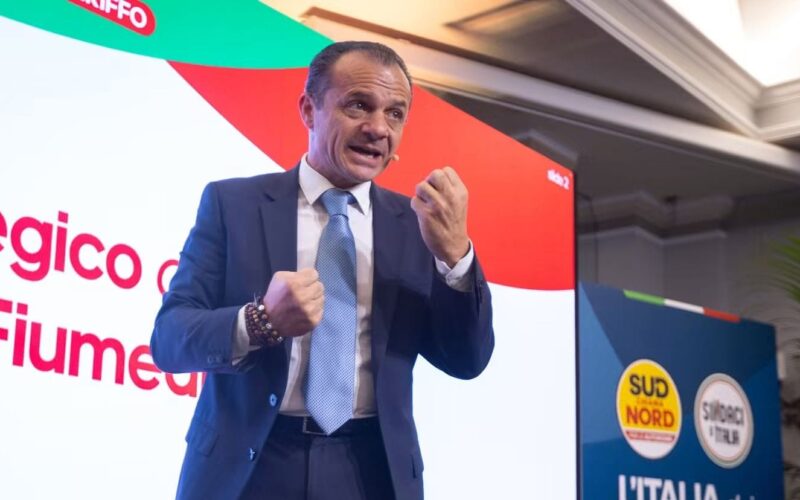
Particularly significant was the intervention of Cateno De Luca, who retraced more than 20 years of administrative experience through episodes, institutional battles, results and choices that have marked his path leading Fiumedinisi, Santa Teresa di Riva, Messina, the Metropolitan City of Messina and, today, Taormina.
“These three days may allow a synthesis and also a common strategy between Sud chiama Nord and Sindaci d’Italia. I have the role of facilitating this synthesis. I am the facilitator,” De Luca said.
It is a journey whose roots lie in the foundation of Sicilia Vera on 18 March 2007, continuing with the birth of Sud chiama Nord in May 2022 and now finding a new national dimension in the meeting with Sindaci d’Italia, established on 4 October in Assisi.
“What we have built over the years, starting from a precise Sturzo-inspired matrix, can today have an overall strategy, a national strategy with Sindaci d’Italia,” he emphasised.
From the budget to the fight against tax evasion: the administrative method becomes a political proposal
At the heart of De Luca’s speech was a veritable lesson in administration aimed at the mayors and would-be mayors present.
The first principle is to start with the accounts and the organisation of the municipal machine.
“The first thing I have always done on entering a town hall is to have the budget brought to me. Because the budget contains everything. There are not only accounting aspects, but the political choices that must find concrete financial backing.”
De Luca insisted on the need to analyse revenue as a priority, verify the real ability to collect, identify uncensored taxpayers and combat tax evasion.
Alongside financial recovery, the reorganisation of the administrative machine, through a review of offices, services and managerial structures.
“The alibi that is often used must end, the one according to which we are in the hands of the bureaucracy. The strategic direction on organisation is the responsibility of the mayor and the municipal executive.”
Among the experiences recalled was the strategic plan “Vivi Fiumedinisi”, launched in 2004 under the Contratti di Quartiere, which, as De Luca explained, enabled the activation of public and private investments worth about €80 million.
An experience that today becomes the starting point for a proposal to be included in the national programme: to promote tools for integrated territorial planning, capable of bringing together private investment, public works, urban development and employment through transparent and simplified procedures.
“This is a simplification strategy. With a single administrative process we can approve more investments, create jobs, generate wealth and requalify the urban context. This is the model we must make ordinary.”
De Luca then recalled the experience of Santa Teresa di Riva, focusing on the initiatives adopted to avoid breaching the stability pact through the early granting of cemetery niches and on actions to recover arrears from the water service.
A story used to highlight the difference between authority and authoritativeness. “Authority is assigned to us by the law.
Authoritativeness we earn ourselves in the field. I prefer to be authoritative and not authoritarian.”
Ample space was also devoted to the experience of Messina, starting with the electoral victory in 2018, achieved without a single municipal councillor elected on the lists supporting the mayor.
De Luca retraced the path of “Salva Messina”, launched to tackle a debt situation quantified at about €555 million, the reorganisation of municipal companies and the financial rebalancing plan.
“When I arrived, Messina was known as the city of rubbish, shacks and financial collapse. We changed the city’s destiny. That civic planning was confirmed in 2022 and again in 2026 with Federico Basile.”
A passage was reserved for the institutional relationship built with Laura Castelli, then deputy minister of the economy, on the occasion of the battle for financial support for the former Sicilian provinces.
An example, De Luca stressed, of institutional collaboration capable of overcoming political affiliations to concretely solve the problems of the territories.
In the concluding part, De Luca illustrated some of the initiatives adopted in Taormina: combating tax evasion, revoking hundreds of free parking passes, reorganising the waste collection service, financial recovery and battles to secure more resources for the city.
Particular attention was devoted to the relationship between municipalities and archaeological sites.
De Luca recalled the result achieved through a regional law that recognises for the municipality of Taormina a share of the revenue from ticket sales at the Ancient Theatre, to support the cleaning, security, mobility and urban decorum services connected to the presence of the site.
“This is one of the things we will propose at national level,” he announced, indicating the possibility of extending the model to Italian municipalities that host major cultural and archaeological attractions.
Among the issues to be addressed is the revision of the legislation on the financial distress of local authorities, so that municipalities that manage to restore their accounts early can be freed from the limitations provided by current legislation without having to wait for the ordinary time limits to elapse.
“The sheriff mayor? Call me what you like, what matters are the results”
The speech was accompanied by the screening of videos and testimonies of the most significant initiatives of his administrative activity: from institutional protests to checks on public services, from interventions against urban decay to actions on security and civil protection.
“Sheriff-style stunts for their own sake are useless. What matters in the end are the results,” De Luca reiterated, claiming a model of administration based on direct presence, taking responsibility and the ability to intervene to solve problems.
The first day of the convention thus marks the start of a debate that must translate into a political and programmatic synthesis between Sud chiama Nord and Sindaci d’Italia.
At its core are the enhancement of local autonomies, administrative simplification, reform of the finances of territorial bodies, the ability to attract investment, the relationship between the state and municipalities and a new political representation built starting from the communities.
The three-day event sees the participation of authoritative representatives of national institutions, including the president of the Senate Ignazio La Russa and the ministers Matteo Piantedosi, Francesco Lollobrigida and Guido Crosetto, as well as the announced intervention of the prime minister Giorgia Meloni.
The political objective of the three days is to transform administrative experiences into a national platform, capable of combining the concreteness of local government with an overall vision for the future of Italy.
From squares, villages and cities takes shape the challenge of L’Italia dei Territori: a politics that starts from listening to communities, measures itself against problems and finds its legitimacy in results.