Translated automatically by AI from the Italian original.
PALERMO, CALTANISSETTA, ROME / INVESTIGATION – From Paolo Borsellino’s briefcase to the false informant Scarantino, from police officers saved by the statute of limitations to the investigation into Gianni De Gennaro, closed by his death on 21 November 2026. Thirty-four years of lies, verdicts and unanswered questions.
Chapter 01 – Five in the afternoon
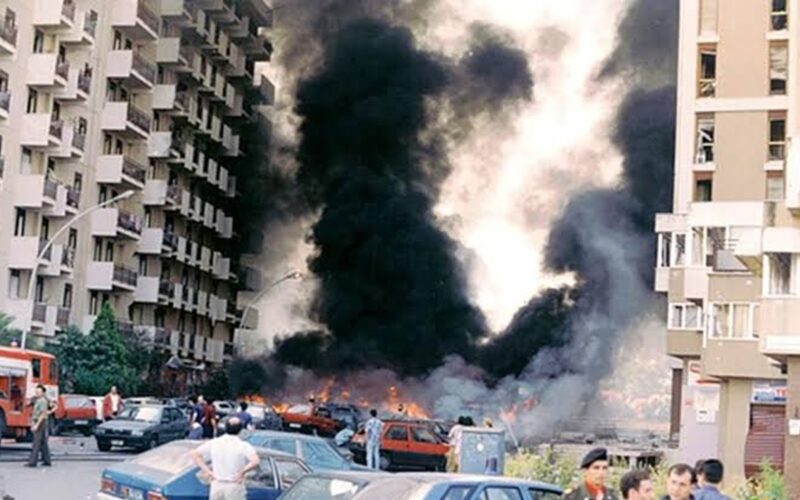
Sunday, 19 July 1992, Palermo. At 4.58pm a Fiat 126 packed with explosives, parked in via Mariano D’Amelio in front of the building where the judge’s mother lived, blew up as Paolo Borsellino rang the doorbell. The magistrate died along with five officers from his escort: Agostino Catalano, Emanuela Loi – the first woman from the National Police (Polizia di Stato) to die on duty – Vincenzo Li Muli, Walter Eddie Cosina and Claudio Traina. Only Antonino Vullo survived; he had been manoeuvring one of the armoured cars.
Fifty-seven days had passed since Capaci. Borsellino knew he was the next target and had said so, with the clarity of someone who understood Cosa Nostra from the inside of its own files. In those eight weeks he had worked without stopping, meeting informants, and had asked to be heard by the Public Prosecutor’s Office in Caltanissetta about Giovanni Falcone’s death. He was never summoned.
As far as execution was concerned, the massacre bore the hallmark of the Corleonesi and the Brancaccio family of the Graviano brothers. On this point the final verdicts leave no doubt. But via D’Amelio is not just the story of an attack: it is the story of what happened afterwards, in the hours, months and years that followed, when the investigation into the massacre was steered towards a convenient truth. It is what the judges, in black and white, have called the most serious cover-up in the history of the Republic.
Chapter 02 – The briefcase and the red diary
The first mystery emerged from the still-smouldering wreckage. Borsellino always carried a red-covered diary, supplied by the Carabinieri, in which he jotted down notes, names and insights. His family and closest colleagues always described it as something he never parted with, especially in the weeks following Falcone’s death. The magistrate’s leather briefcase was recovered from the car. When it was returned to the family, the diary was missing.
A photograph taken that afternoon shows a Carabinieri officer, Captain Giovanni Arcangioli, walking away from the explosion site with a bag in his hand. Arcangioli was investigated for the theft of the diary and cleared: the reconstruction of how the briefcase changed hands, amid contradictory testimony and faded memories, did not allow the case to go to trial.
Since then the red diary has become the symbol of everything that does not add up about via D’Amelio. It has never been found. And for many, starting with the judge’s brother, Salvatore Borsellino, its disappearance is the true founding act of the cover-up: someone, in those minutes, knew exactly what to look for.
In recent years the Public Prosecutor’s Office in Caltanissetta has followed a precise lead: according to investigators, the diary ended up in the hands of Arnaldo La Barbera, the head of the Flying Squad who would soon lead the investigation into the massacre. It was on this hypothesis that, in September 2023, searches were carried out in the homes of the police officer’s relatives; La Barbera died in 2002. And it was from here that, three years later, the investigation would reach the top of the police force at the time.
Chapter 03 – The Falcone and Borsellino team
After the massacres, the state responded by creating a dedicated investigative team, the “Falcone and Borsellino” group, entrusted to Arnaldo La Barbera. A highly respected official, considered a super-cop, La Barbera was in charge of the via D’Amelio investigation. Around him worked men from Palermo’s Flying Squad, including the official Mario Bo and inspectors Fabrizio Mattei and Michele Ribaudo.
Much of what is known today about La Barbera emerged after his death. Court documents revealed that, in the previous years, he had been a paid collaborator of the Sisde, the civilian secret service, under a code name. In the appeal trial on the cover-up, the Public Prosecutor’s Office produced findings by the financial police (Guardia di Finanza) on payments considered anomalous into his accounts. A collaborator of justice testified in court about close ties between the police officer and certain Cosa Nostra figures. None of these circumstances was ever examined in a trial against him: La Barbera died with a clean record and was unable to defend himself.
What the judges have established, however, is the method. The investigation into the massacre did not follow the most promising leads, but focused on a trail constructed around a man who had nothing to do with the massacre.
Chapter 04 – Vincenzo Scarantino, the fabricated informant
Vincenzo Scarantino was a small-time criminal from Guadagna, a Palermo district. He dealt drugs, had a minor record, and had a brother-in-law connected to mafia circles. He held no significant role in Cosa Nostra. Yet, at the end of September 1992, he was arrested as one of the perpetrators of the massacre, accused of having procured the Fiat 126 used as the car bomb. His name came from statements by Salvatore Candura, another district lowlife, who claimed to have stolen the car on Scarantino’s orders. Francesco Andriotta, a cellmate, then reinforced the story by reporting alleged confidences. Calogero Pulci would later join them. These were three fragile sources, propping each other up.
In June 1994, after a period of extremely harsh detention in Pianosa prison, Scarantino began to collaborate. He accused himself of the massacre and implicated a series of alleged accomplices. He described a meeting in a villa where the bosses had supposedly decided on the attack, and named men who would later receive life sentences. His account was full of inconsistencies, but it was progressively adjusted. Later it would emerge that the statements had been annotated, that the collaborator had received suggestions, and that the site inspections had been staged.
Even then, not everyone believed him. In 1994 two magistrates from the Public Prosecutor’s Office in Caltanissetta, Ilda Boccassini and Roberto Sajeva, wrote down their doubts about Scarantino’s reliability before leaving the office. That note remained in a drawer for a long time. Scarantino himself, in the summer of 1995, recanted in a television interview, denouncing that he had been forced to accuse innocent people. Then he recanted again. In September 1998, during a hearing of the Borsellino bis trial held in Como, he again told the court that he had made everything up under pressure. He was not believed.
Chapter 05 – Three trials built on sand
Those statements led to the first trials. The Borsellino uno trial ended at first instance in January 1996 with three life sentences and 18 years for Scarantino himself. The Borsellino bis trial widened the number of defendants and led to a series of life sentences, later confirmed up to the Court of Cassation (Italy’s highest court). The Borsellino ter trial, which judged the Cosa Nostra leaders as the masterminds, followed a partly separate track.
The paradox, which subsequent trials would expose, was that truth and lies coexisted in the same file. The Commission’s leaders were indeed guilty; but alongside them, men who had nothing to do with the car bomb were also convicted. Some of them spent almost 20 years in prison, many under the 41 bis regime, for a crime they had not committed.
For a long time, however, the Scarantino trail represented the judicial truth. And those who contested it, defence lawyers above all, were viewed with suspicion. Among them was the lawyer Rosalba Di Gregorio, who for years had denounced the inconsistency of the Guadagna informant and who, even in 2024, before the Court of Appeal in Caltanissetta, would say that the cover-up had never truly ended.
Chapter 06 – Spatuzza: I stole the 126
The turning point came in 2008. Gaspare Spatuzza, a Brancaccio killer and loyal follower of the Graviano brothers, sentenced for dozens of murders including that of Don Pino Puglisi, decided to cooperate with justice. One of the first things he revealed was about via D’Amelio: he had stolen the Fiat 126 himself, on his bosses’ orders, not Scarantino. He described the theft, the methods, and the place where the car was kept and prepared. The checks confirmed he was telling the truth.
The edifice built 16 years earlier collapsed at once. If Spatuzza was telling the truth – and the verifications confirmed it – then Candura, Andriotta and Scarantino had lied, and someone had helped them lie convincingly. The question was no longer who had physically stolen the car, but who had constructed the falsehood and why. Two consequences followed. On the one hand, the revision trial for the wrongly convicted began: in July 2017 the Court of Appeal in Catania quashed their convictions. On the other, the Public Prosecutor’s Office in Caltanissetta launched a new investigation into the massacre, which would lead to the Borsellino quater trial, and a parallel investigation into who had guided the false collaboration.
Chapter 07 – Borsellino quater: the word “cover-up” enters the verdict
On 20 April 2017 the Assize Court in Caltanissetta delivered the Borsellino quater verdict. It sentenced bosses Salvino Madonia and Vittorio Tutino to life imprisonment; it convicted Francesco Andriotta and Calogero Pulci for slander; for Scarantino the offence was declared time-barred, recognising that he had been induced to lie by others.
But the heart of the decision was the reasoning, filed in the summer of 2018. The judges wrote that the false collaboration was not the result of a mistake, but of a design: the investigators had distortedly exercised their powers, with pressure, suggestions and manipulation. And it was here that the formula destined to endure first appeared in a verdict: one of the most serious cover-ups in Italian judicial history.
The Court went further. It asked why part of the apparatus had an interest in quickly closing the case by pointing to the wrong culprits, and linked this question to the disappearance of the red diary. It did not give a definitive answer, but indicated a direction: the hypothesis that behind the massacre, alongside Cosa Nostra, there were other interests that needed to be shielded. The verdict later became final. In 2018 the Sicilian Regional Assembly’s anti-mafia commission also dedicated an investigation and a final report to the cover-up, retracing Scarantino’s site inspections, the annotated statements and the Boccassini and Sajeva note that had gone unheeded.
Chapter 08 – The police officers in the dock
On 28 December 2018 three men from La Barbera’s team were committed for trial: the official Mario Bo and the inspectors Fabrizio Mattei and Michele Ribaudo. The charge was complicity in aggravated slander by aiding Cosa Nostra: they were accused of inducing Scarantino to falsely accuse innocent people, preparing him, instructing him and correcting his statements.
The trial in Caltanissetta lasted for years. Magistrates, former investigators and collaborators paraded through the courtroom. Many witnesses from the security forces responded with an impressive series of “I don’t remember”. The Public Prosecutor’s Office requested 11 years and 10 months for Bo and nine and a half years for the other two. The defence spoke of a media pillory and novelistic reconstructions, recalling that the public prosecutors of the time had endorsed Scarantino’s statements.
On 12 July 2022, after 11 hours of deliberation, the Court recognised that the cover-up had taken place and that Bo and Mattei had been the protagonists. But the mafia-related aggravating circumstance fell: it was not proven that they knew they were aiding Cosa Nostra. Without the aggravating circumstance, the slander was time-barred. Ribaudo was acquitted because the act did not constitute an offence. The result was what many commentators summed up with bitterness: the most serious cover-up in history without culprits.
Chapter 09 – Appeal and Cassation: the final word on the three defendants
The Public Prosecutor’s Office and the civil parties appealed. In 2024 the Court of Appeal in Caltanissetta, presided over by Giovanbattista Tona, confirmed the statute of limitations for Bo and Mattei and declared it also for Ribaudo, who at first instance had been acquitted on the merits. For the civil parties, including the judge’s children assisted by the lawyer Fabio Trizzino, husband of Lucia Borsellino, it was still a step forward: the Court recognised that all three had contributed to the cover-up.
The reasoning was filed on 2 March 2026 and carried enormous political weight. According to the judges, La Barbera had not made simple mistakes: he had knowingly directed an operation to construct a truth stripped to the bone, useful for protecting interests and centres of power outside Cosa Nostra, even within the apparatus. The police officer, the Court essentially wrote, knew he was covering responsibilities other than those of the mafiosi. However, it remained unclear what Cosa Nostra would have gained from this.
The judgment on the three defendants was severe: they had followed the boss’s directives, aware that they were building the credibility of an unreliable collaborator, and had worked to neutralise the elements that contradicted the accusations. The intent of the slander was there; what was missing was proof, beyond reasonable doubt, that they were aware they were aiding the mafia. Hence the statute of limitations.
In September 2026 the sixth criminal section of the Court of Cassation rejected all appeals, those of the defence and that of the Public Prosecutor’s Office in Caltanissetta, which had insisted on the aggravating circumstance. The appeal verdict became final. For Bo, Mattei and Ribaudo the trial was over. The cover-up was an established fact, but no one would be held criminally responsible.
Chapter 10 – Why no one pays: the legal knot
To understand how the most serious cover-up in republican history could end without convictions, one must look at the penal code. The offence of cover-up, article 375, was introduced only in 2016, with law no. 133. For the events of the 1990s it could not be contested, because criminal law is not retroactive. The Public Prosecutor’s Office therefore had to charge the police officers from La Barbera’s group with slander, under article 368: falsely accusing someone knowing them to be innocent, or inducing others to do so.
Slander, in its simple form, has limitation periods that for conduct dating back to 1992 and 1994 had long since expired. The only way to keep the trial alive was the aggravating circumstance of acting to aid Cosa Nostra, which increases the penalty and consequently extends the time limits. But to recognise it, proof is needed that the defendant knew they were aiding the mafia organisation. The judges considered it proven that the three police officers knew they were constructing false accusations; not that they knew they were playing into the mafia’s hands. With the aggravating circumstance gone, the trial collapsed.
There is then a second paradox. The appeal reasoning identified La Barbera as the knowing director of the operation and spoke of interests outside Cosa Nostra; but the man who, according to the judges, knew of those links had died in 2002, before it was even discovered that Scarantino was lying. The trial could only judge the executors, not those who had given the orders. The investigation into De Gennaro moved on different ground: the contested conduct dated from between 2023 and 2025 and for these the offence of cover-up was fully applicable. It was, for this reason, the first attempt to bring before a judge not a historical hypothesis, but recent behaviour. An attempt that the death of the person under investigation interrupted.
Chapter 11 – Scarantino, victim and tool
On 30 May 2026 the Court of Appeal in Perugia revoked the eight-year sentence for aggravated slander imposed on Vincenzo Scarantino on 27 December 2002 by the preliminary investigations judge in Rome. That conviction did not concern the accusations against the innocent of via D’Amelio, but the retraction of 1998: Scarantino had been punished for accusing magistrates, managers and police officials of having pushed him to lie. In the light of the cover-up verdicts, those accusations could no longer be considered slanderous. The eight years of punishment, however, had already been served.
Scarantino’s figure remains ambiguous. He lied, he retracted, he lied again. But subsequent verdicts clarified that those lies did not arise on their own. The Guadagna informant knew nothing about the massacre: what he said had been put into his mouth.
Chapter 12 – The mafia and contracts trail
Alongside the question of who carried out the cover-up, there is another that has divided magistrates, scholars and politicians for years: why was Borsellino killed so quickly, just 57 days after Falcone? Over time, different interpretations have clashed: the negotiation between parts of the state and Cosa Nostra, the so-called black trail linked to subversive right-wing groups, the mafia-and-contracts dossier.
The latter is the report drawn up by the Carabinieri’s Ros, under Mario Mori and Giuseppe De Donno, on the links between Cosa Nostra, business and politics in the division of public works in Sicily. Falcone had wanted it; Borsellino had been looking into it in his final weeks. On 13 July 1992 the Public Prosecutor’s Office in Palermo signed the request to archive part of that investigation; the next day, 14 July, a meeting was held at the Public Prosecutor’s Office which Borsellino attended.
Under the presidency of Chiara Colosimo, the parliamentary anti-mafia commission placed the dossier at the centre of its work on the massacre, with dozens of hearings and fierce political confrontation. The president repeatedly defined via D’Amelio as the greatest cover-up in Italian history and announced a final report for autumn 2026. From the opposition, the Five Star Movement senator Roberto Scarpinato, former public prosecutor of Palermo, accused the majority and the Public Prosecutor’s Office in Caltanissetta of isolating via D’Amelio from the other massacres and of turning the commission into a media tribunal.
On 3 October 2026 the preliminary investigations judge in Caltanissetta, Santi Bologna, with a decree of over 600 pages, archived the investigation against unknown persons on the mafia-and-contracts motive, accepting the request of the public prosecutor Salvatore De Luca and his deputy Pasquale Pacifico. The elements collected, the judge wrote, did not allow any person under investigation to be registered nor a reasonable prediction of conviction to be formulated. But the order was not neutral: for the judge, Borsellino had not been informed, either before or during the 14 July meeting, of the request to archive signed the previous day, and the matter was read as a possible contributing cause of the massacre.
The decree also contained a passage that immediately became a political issue: the judge attributed depistante activity to Scarpinato. The centre-right called on the senator to leave the commission; he rejected everything and instead defined himself as the one who had been misled. The local board of the National Magistrates Association expressed solidarity with the judge. At the same time, the position of the former magistrate Gioacchino Natoli was archived. On the opposite front, part of the press criticised the close collaboration between the commission and the Public Prosecutor’s Office in Caltanissetta, speaking of anomalous procedures and a counter-investigation that pilloried former magistrates without trial. Finally, the judge indicated to the Public Prosecutor’s Office a direction to restart the investigation into the massacre: return to the material origin of the attack, starting with the Fiat 126.
Chapter 13 – The investigation into Gianni De Gennaro
In mid-November 2026 the news broke in newsrooms: Gianni De Gennaro, former head of the police, was under investigation by the Public Prosecutor’s Office in Caltanissetta for cover-up, as part of the investigation into the via D’Amelio massacre and the disappearance of the red diary. The previous Thursday, Carabinieri from the Ros had searched properties at his disposal and seized his telephone and computer.
The name carried weight like few others. Born in Reggio Calabria in 1948, he joined the police in 1973. De Gennaro was one of the police officers closest to Giovanni Falcone: in 1984 he handled the extradition from Brazil of Tommaso Buscetta; in 1989 he became the first director of the Sco; between 1992 and 1993 he was at the top of the Dia. Head of the police from 2000, he went through the G8 season in Genoa, from which he was definitively acquitted in the trial linked to the Diaz school. He would later become head of cabinet at the Interior Ministry, director of the Dis (which coordinates the secret services), undersecretary with responsibility for intelligence in the Monti government, president of Finmeccanica and then Leonardo, and finally president of the Eurolink consortium for the Strait of Messina bridge.
The accusations, according to the Public Prosecutor’s Office reconstruction, moved on two tracks. The first was a declaratory cover-up: De Gennaro, through his long-time collaborator Francesco Pacetto and his protection officer Massimo Carnicelli, had induced the collaborator of justice Salvatore Contorno not to speak to the magistrates. On 15 May 2025 Contorno, summoned to Caltanissetta, had exercised his right to remain silent.
The second track was a material cover-up. After the searches in September 2023 in the homes of La Barbera’s relatives, De Gennaro, the Dis official Donatella Peruzzi and Carnicelli had moved and hidden paper and digital documents; others had been destroyed. In the Ros wiretaps, according to what was reported by L’Espresso, the former head of the police had said: “I’ve destroyed everything by now.”
The public prosecutors contested two aggravating circumstances: acting to aid Cosa Nostra, by preventing the identification of external subjects who had participated in the massacre, and to cover up responsibilities in the disappearance of the red diary. On file there was also the hiring in the services of La Barbera’s daughter, who according to the accusation had been favoured by De Gennaro.
The Public Prosecutor’s Office requested house arrest for De Gennaro and Pacetto and suspension from duties for Carnicelli. The preliminary investigations judge Giulia Zappalà refused. According to the public prosecutor De Luca, the judge did not contest most of the facts, but gave them a different legal interpretation: the material cover-up could be configured only if it were proven that the hidden or destroyed documents were connected to the removal of the red diary. The Public Prosecutor’s Office, however, believed that the conduct concerned a broader perimeter: Contorno’s return to Palermo in 1989, the anonymous letters from the “Raven” accusing Falcone and De Gennaro himself, the failed Addaura attack, the season of massacres, the false informant Scarantino.
On 12 November the public prosecutors filed an appeal with the review court, which set the hearing for 1 December. On the opposite front, critical voices were not lacking: Il Foglio contested the solidity of the accusation, observing that the conversations did not reveal any order from De Gennaro and that it had been Contorno himself who called Pacetto to tell him that he did not intend to answer. It should be reiterated that De Gennaro was never committed for trial nor convicted for these facts.
Chapter 14 – 21 November 2026
On Saturday, 21 November, in the morning, Gianni De Gennaro was found dead in his country house in Maremma, where he had gone alone. He was 78. The alarm was raised by people working in the house after the family had been unable to contact him. According to initial reconstructions, the former head of the police took his own life.
At the scene the duty magistrate from the Public Prosecutor’s Office in Grosseto and the public prosecutor from the DDA in Florence, Rosa Volpe, arrived; the Carabinieri’s Ris carried out the surveys. According to what was reported by Sky Tg24, proceedings were also opened for the hypothesis of instigation to suicide. Sources close to the former prefect described a man devastated by the investigation. The undersecretary Alfredo Mantovano remembered him as a servant of the state. His lawyer, Francesco Bertorotta, who was assisting him with the charges formulated in Caltanissetta, confirmed the news.
Legally, the death of the person under investigation extinguishes the offence against him, under article 150 of the penal code. This means that there will never be a judgment on De Gennaro’s position: neither a conviction nor an acquittal. The proceedings may continue for the other persons under investigation, but the person around whom the most serious hypothesis revolved can no longer be heard. Once again, as happened with La Barbera’s death in 2002, the procedural truth about via D’Amelio lost one of its possible key witnesses.
Chapter 15 – What remains
Thirty-four years after the massacre, the fixed points are few but solid. Cosa Nostra designed and carried out the attack, and its leaders were convicted. The first investigations were diverted through a false informant constructed from scratch, and at least three police officers from the investigative team participated with intent. Innocent people served very long sentences. The red diary disappeared and was never found.
As for the rest, starting with the why, the verdicts offer hypotheses rather than certainties. The courts in Caltanissetta speak of interests and centres of power outside Cosa Nostra that the cover-up was meant to protect, but no external subject has ever been convicted for the massacre. The trails remain competing: mafia and contracts, negotiation, black trail. Each has its supporters, in the courtrooms as in parliament, and the clash between these interpretations has become, in recent years, a political clash as well.
Meanwhile, the judicial balance of the cover-up is closed by limitation and by death. La Barbera died before being tried; Bo, Mattei and Ribaudo were recognised as authors or accomplices in the slander but saved by time; De Gennaro died before a judge could evaluate the accusations. The anti-mafia commission is preparing to deliver its report, the Public Prosecutor’s Office in Caltanissetta continues to investigate, and the review court was due to rule on 1 December. The question that Paolo Borsellino, in a certain sense, left us as a legacy in the pages of that diary remains: who had an interest in preventing him from speaking, and who, afterwards, had an interest in preventing it from being known. For now, the answer is in no verdict.