Translated automatically by AI from the Italian original.
PARIS – A Saturday of fiery protest and high tension swept from north to south through France’s main cities. The great national mobilisation against the high cost of living, the loss of purchasing power and in defence of public services ended with two starkly contrasting tallies: on the one hand, an impressive popular turnout—albeit at the centre of the usual war of numbers between government and unions—and on the other a very heavy public order balance sheet, with almost 1,000 arrests nationwide.
The day saw unions, student organisations, workers and yellow vest movements march together, staging 136 processions and local demonstrations that for many hours proceeded largely peacefully.
War over the numbers on the streets: up to 800,000 protesters
As is customary during France’s major strikes, the estimates of actual participation show a wide gap between the sides:
- Interior Ministry estimates: At the end of the day the French Home Office put the total number of protesters nationwide at 410,000 (including 110,000 in Paris alone). Compared with the previous Saturday (17 October), the government estimates a drop in attendance.
- Union estimates (CGT): The union confederation claimed a turnout of about 800,000 people across France (with a peak of 250,000 in Paris), arguing that the protest movement had held firm on a national scale.
Tensions and incidents in Paris and the provinces
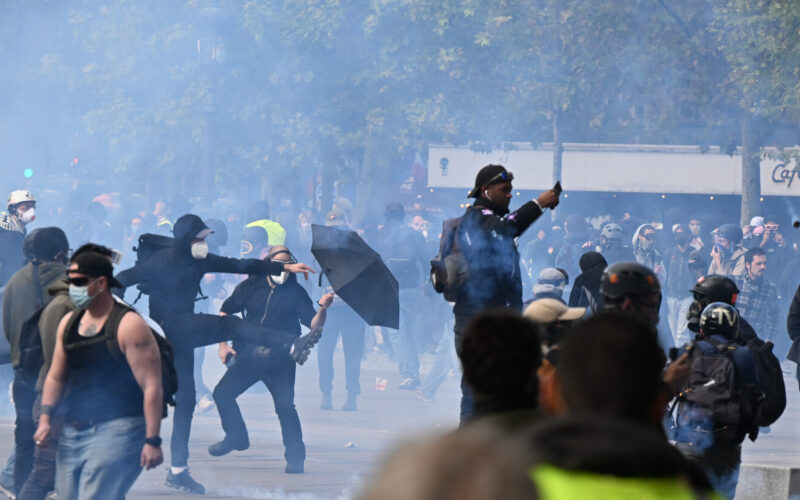
Although the marches passed off largely peacefully in the morning, the atmosphere heated up in the late afternoon as the demonstrations began to disperse.
In Paris, the most violent clashes were concentrated around Porte de Vincennes, where more than 500 protesters confronted the police with a barrage of objects and stones. The police and riot units responded with heavy use of tear gas and water cannon to disperse the crowd, creating moments of great confusion for thousands of citizens trying to leave the area after the march.
Chains of tension and incidents were also reported in other major French cities:
- Lyon, Marseille and Toulouse: Police staged clearing charges and used tear gas in the evening.
- Nantes and Grenoble: Incidents sparked by attempts by groups of protesters to breach the prohibited perimeters set by the Prefecture. In Grenoble, several shop windows were damaged and vandalised.
Almost 1,000 arrests and the Home Office’s preventive checks
In the evening briefing, Interior Minister Laurent Nuñez confirmed a provisional total of almost 1,000 arrests across France.
Nuñez defended the security operation, stressing that a significant proportion of the arrests stemmed from preventive checks carried out from the morning at stations and at the entrances to historic centres, with the seizure of large quantities of potential offensive material. According to the authorities, the clampdown on the streets prevented systematic looting of the kind seen in previous weeks.
Social pressure in France remains extremely high, and the unions have announced they will not stop until they receive concrete responses from the government on wage and energy policies.