Translated automatically by AI from the Italian original.
Developed in Switzerland to operate in otherwise inaccessible spaces
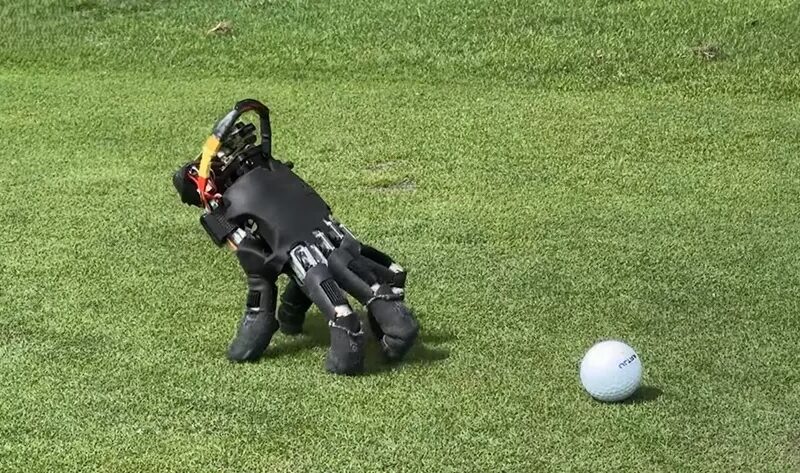
Researchers at the Soft Robotics laboratory of the Swiss Federal Institute of Technology in Zurich (ETH) have designed a robotic hand capable of moving autonomously on its five fingers, testing it on 14 different surfaces: from tiles to metal grilles, gravel and grass. The project, internally dubbed “loco-manipulation”, merges mobility and gripping ability into a single limb, overcoming the traditional robotic approach that separates these two functions. The goal is to reach confined spaces inaccessible to conventional robots.
The design
The device is based on a commercial model, the WUJI Hand, enhanced with a Raspberry Pi Zero 2W mini-computer, a battery and a motion sensor (IMU), all mounted on the back for a total weight of 818 grams. Each finger has four motorised joints — 20 in total — and replicates the real proportions of a human hand. This choice proved crucial: early prototypes with uniform fingers had serious balance problems due to poor centre-of-gravity distribution.
Thanks to reinforcement learning, the hand has learned to coordinate its fingers asymmetrically. Tests showed the device can right itself after a fall in 21 out of 25 cases, press the correct keys on a keyboard in 29 out of 32 attempts and even sink a golf ball.
Practical applications and current limitations
The Swiss engineers are targeting scenarios where quadruped robots — such as those from Boston Dynamics — are too bulky: inside server cabinets, high-density industrial shelving or the rubble of collapsed buildings during rescue operations. In these contexts, the small size and light weight are a decisive advantage, opening interesting prospects for warehouse automation in densely populated urban areas.
However, some limitations remain: the movement speed is far slower than traditional robots (a few centimetres per second compared with over one metre per second for Boston Dynamics’ Spot model), and data on the mechanical strength of the joints under continuous load have yet to be released. The device remains a research prototype with no planned commercial release date, but it represents an extremely promising solution for operating where no other robot can reach.