Translated automatically by AI from the Italian original.
“A dream that is not interpreted is like a letter that is never read,” runs an ancient text.
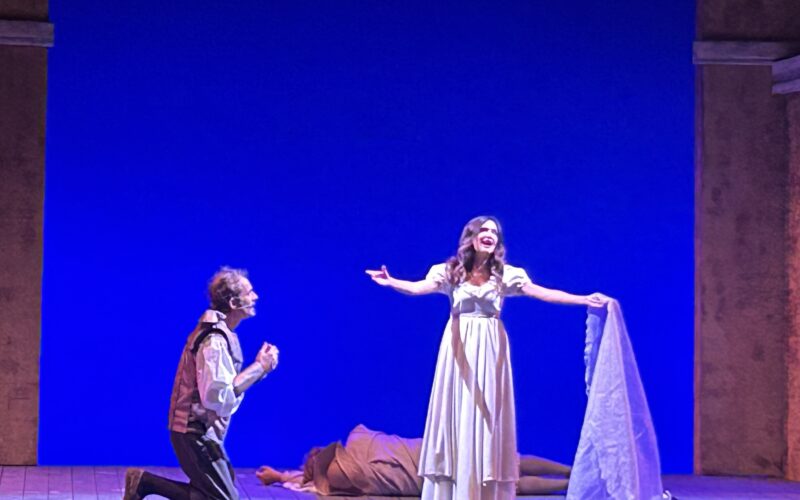
A knight arrives from Girgenti and charges at the temples of Agrigento—no longer a knight of La Mancha tilting at windmills. And it is Toni Cucchiara, present at the Syracuse premiere, who brings Don Quixote from Girgenti to the stage, a character beloved by Sicilian audiences for over 30 years. He manages to make everyone smile, the learned and the unlearned alike, for that is the nature of Don Quixote and his faithful squire. The cast is exceptional: Vincenzo Volo as the dear and loyal Sancho Panza, Ruben Rigillo as the dreamer and would-be knight, with Laura Sfilio as Dulcinea of Joppolo, Lucia Portale as Nunna, Cosimo Coltraro (Don Pircoco), Emanuele Puglia (Don Cornelio), Pietro Casano (Ronzinante), Alex Caramma (Fra’ Nespola), Giovanna Mangiù (Lia) and Lorenza Denaro (Filomena). They are joined by Ettore Iurato, Giorgia Morana, Lucio Rapisarda and Giada Romano as the villagers. The soundtrack is perfect, with musical direction by Franco Lazzaro and songs such as Sognare sì, Caru Patruni and Alla scala dei turchi. The choreography, Sicilian with futuristic touches, is by Giorgia Torrisi Lo Giudice, with sets and costumes by Vincenzo La Mendola. Stefano Buda’s photographs are beautiful. The story is well known: escaping reality for other places or dreamlike dimensions to get away from a wife he does not love—indeed, one forced upon him by the passage of time and the insistence of his loyal Sancho, who is also her brother. Don Quixote, a pseudo-“enlightened” figure, tries to convince everyone he meets to live stories of freedom, of denied rights, of false chivalry, and finds salvation in Dulcinea, who soothes and sweetens the dream.
But what is a dream? It is our way of exploring, of travelling to common and uncommon places, of glimpsing a way out. It is the ability to imagine a future that distances us from a lived reality, sometimes stagnant, from what we have acquired as established, unchangeable knowledge from the past, developing new thoughts so we can live in a world that is constantly changing. Theatre, literature, music and art in general often convey dreams: one example is Spielberg’s film studio, DreamWorks Animation, which means “dream works” or “dreams work”. Whether it is his origins or the fact that he has travelled inside fantasy for so long, Spielberg has managed to turn dreams into film and take us back into the dream when we go to the cinema. Walt Disney, too, loved to tell his friends and colleagues, “If you can dream it, you can do it.” He dreamed of talking mice and anthropomorphic animals and took everyone along the lightest paths of fantasy. Don Quixote, however, only dreamed of ways out but found no one to turn the dream into reality, waking to the harsh, vulgar ways of his wife, who ordered him to go to the fields to tend to seeds and animals in the company of his faithful Sancho, who at least remains real.